

MCP Servers Explained for Technical Writers:
Technical writers are often on the front line of explaining complex technology to a broader audience. As artificial intelligence systems become more integrated into software products and workflows, it’s important to understand the underlying components that power them. One such component gaining attention in 2025 is the MCP server, and while it may seem technical at first glance, its impact on how AI systems access data and tools is valuable context for writing effective documentation.
In simple terms, an MCP server is a backend service that enables an AI model or agent to connect with real-world data and capabilities it wouldn’t otherwise have access to. This connectivity opens up opportunities for richer, more useful interactions… the sort that documentation teams might build guides around or explain in product content.
Want to know more about the latest AI tools?
As well as “How to Build a Metadata Strategy”. See our latest blog on Top 5 Tools for Technical Writing in 2025 for more information.
What Is an MCP Server?
An MCP server stands for Model Context Protocol server. It is part of a standardized framework that lets AI models communicate with external systems like databases, APIs, file stores, or software services in a consistent way. Instead of operating in isolation on training data or static inputs, the AI can pull in live data and tools through the MCP server.
Source: Medium
For documentation teams, think of an MCP server as a bridge. It translates requests from an AI model into structured actions that fetch real, up-to-date information. This can include customer records, product documentation, or any structured content you maintain, making the AI context-aware rather than guesswork-based.
Source: Cloudflare
For technical writers, it can help to think of an MCP server as a controlled gateway. It receives requests from an AI model, retrieves the appropriate information from connected systems, and returns that information in a format the AI can understand and use.
This architecture enables AI systems to stay current, accurate, and useful in real-world environments.
Why MCP Servers Matter to Technical Writers
AI-powered products are increasingly expected to go beyond generating text. Users want smart assistants that can:
- Retrieve the right documentation excerpt based on a question
- Execute product actions through connected tools
- Provide up-to-date responses based on live data
- Navigate complex systems with minimal prompting
MCP servers make this possible by exposing your content and tools securely and consistently. They help standardize how AI systems access context, something technical writers should understand when documenting AI-driven features, workflows, or integrations.
Source: DataDog
How MCP Servers Work (Without the Jargon)
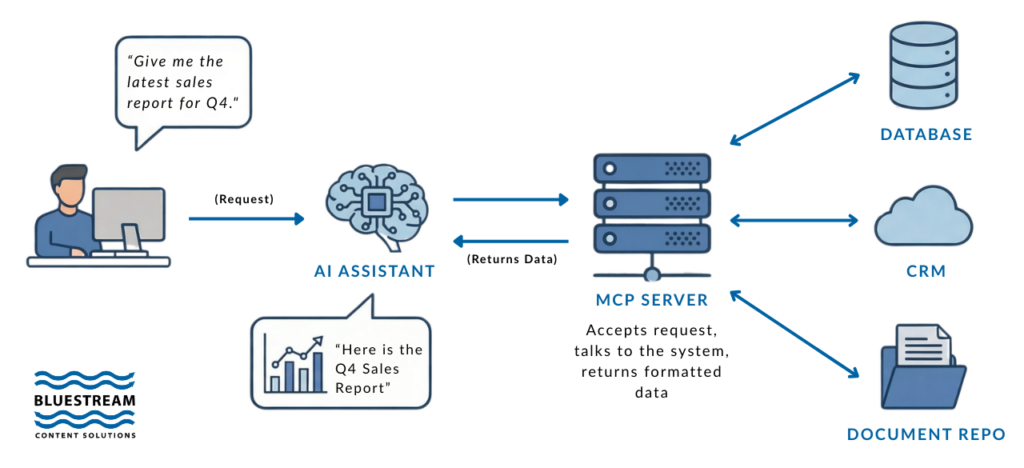
Imagine a user asks an AI assistant to “Give me the latest sales report for Q4.” The model itself doesn’t know your company’s sales figures – it needs access to a database.
An MCP server is what:
- Accepts that request from the AI
- Talks to the database or system where the data lives
- Returns the sales report data in a format the AI can use
This pattern repeats for any system… a document repository, codebase, CRM, or even a help center. MCP servers are built so AI models don’t need custom connectors every time they integrate with a new system.
Source: Exploding Topics
What This Means for Documentation
As AI becomes embedded in products and services, technical documentation will need to:
- Explain how AI features access and interpret customer data
- Clarify security and privacy implications of real-time data access
- Illustrate workflows that involve AI tools interacting with systems
- Detail API behaviors or protocol standards when needed
Technical writers will increasingly be expected to write for intelligent systems as well as human readers. Understanding the role of MCP servers positions you to write better guides, APIs documentation, integration guides, and contextual help that bridges human and machine understanding.
Source: Medium
Practical Scenarios Where MCP Matters
Here are examples where MCP servers intersect with documentation needs:
AI-Assisted Help Systems
If your product uses AI to answer customer questions from your documentation, an MCP server may be how the AI fetches the right information in real time.
AI-Assisted Help Systems
When documenting features that connect to external apps (like CRM, Git systems, or analytics tools), understanding how AI clients use MCP can help you explain setup and behavior clearly.
AI-Assisted Help Systems
Documentation for developers integrating with AI-enabled APIs will benefit from MCP context, especially when describing how to structure requests or interpret responses from AI clients through MCP servers.
AI-Assisted Help Systems
When internal AI agents are used for support or engineering teams, MCP servers help unify content. Something your documentation can explain in onboarding guides or best practices.
Source: Obot AI
Get Started Learning More
If you want a deeper look at how MCP servers function or how they are used by products today, here are useful resources to explore:
Learn about the underlying protocol standard for MCP itself:
https://en.wikipedia.org/wiki/Model_Context_Protocol Wikipedia
A straightforward definition with real-world context:
https://www.legitsecurity.com/aspm-knowledge-base/whats-an-mcp-server-model-context-protocol-explained legitsecurity.com
A discussion of how MCP helps AI tools scale and integrate:
https://www.datadoghq.com/knowledge-center/mcp-server/ Datadog
Final Thoughts
MCP servers may operate behind the scenes, but their impact is visible in the way AI-powered products behave and respond. For technical writers, understanding MCP servers provides valuable insight into how AI systems access information, interact with tools, and deliver results to users.
As AI continues to shape documentation practices, concepts like MCP servers will become part of the shared vocabulary between writers, developers, and product teams. Learning them now puts documentation teams in a stronger position to support the next generation of intelligent systems.
Frequently Asked Questions:
What is an MCP server?
An MCP server is a service that supports the Model Context Protocol by allowing an AI model to connect to external systems such as documentation repositories, APIs, or databases. Instead of relying only on static inputs or training data, the AI can retrieve relevant, up-to-date information through the MCP server.
What does MCP stand for?
MCP stands for Model Context Protocol. It is a standardized approach that defines how AI models request context and interact with tools or data sources through a server.
Why should technical writers care about MCP servers?
Technical writers should care about MCP servers because they influence how AI features retrieve documentation, access live data, and respond to user questions. Understanding MCP servers helps writers explain AI behavior accurately, especially when documenting permissions, data sources, and system boundaries.
How do MCP servers relate to documentation chat & AI help systems?
In AI-powered documentation chat or help systems, an MCP server often acts as the bridge between the AI assistant and the documentation source. The AI sends a request, the MCP server retrieves the most relevant content, and the AI uses that information to generate a response for the user.
Do MCP servers allow AI to access real-time or updated information?
Yes. MCP servers can connect AI models to current information stored in connected systems. This can include updated documentation, configuration data, or other live content, depending on how the MCP server is configured and what permissions are in place.
What should documentation include when a product uses MCP servers?
Documentation should clearly explain what information the AI can access, which systems are connected through the MCP server, how permissions and security are enforced, and what users should expect when responses depend on live or dynamic data.
Want to See XDelivery CDP & XDocs CCMS in Action?
Looking to modernize your documentation process with AI?
Let’s connect. Contact Bluestream to learn how our native integration with oXygen XML Editor/Author can elevate your structured authoring environment. From authoring to review to multichannel publishing, we support the workflows that power your content lifecycle.
