
Documentation operations

The Documentation Bottleneck Problem: What’s Slowing Down Your Tech Writers?

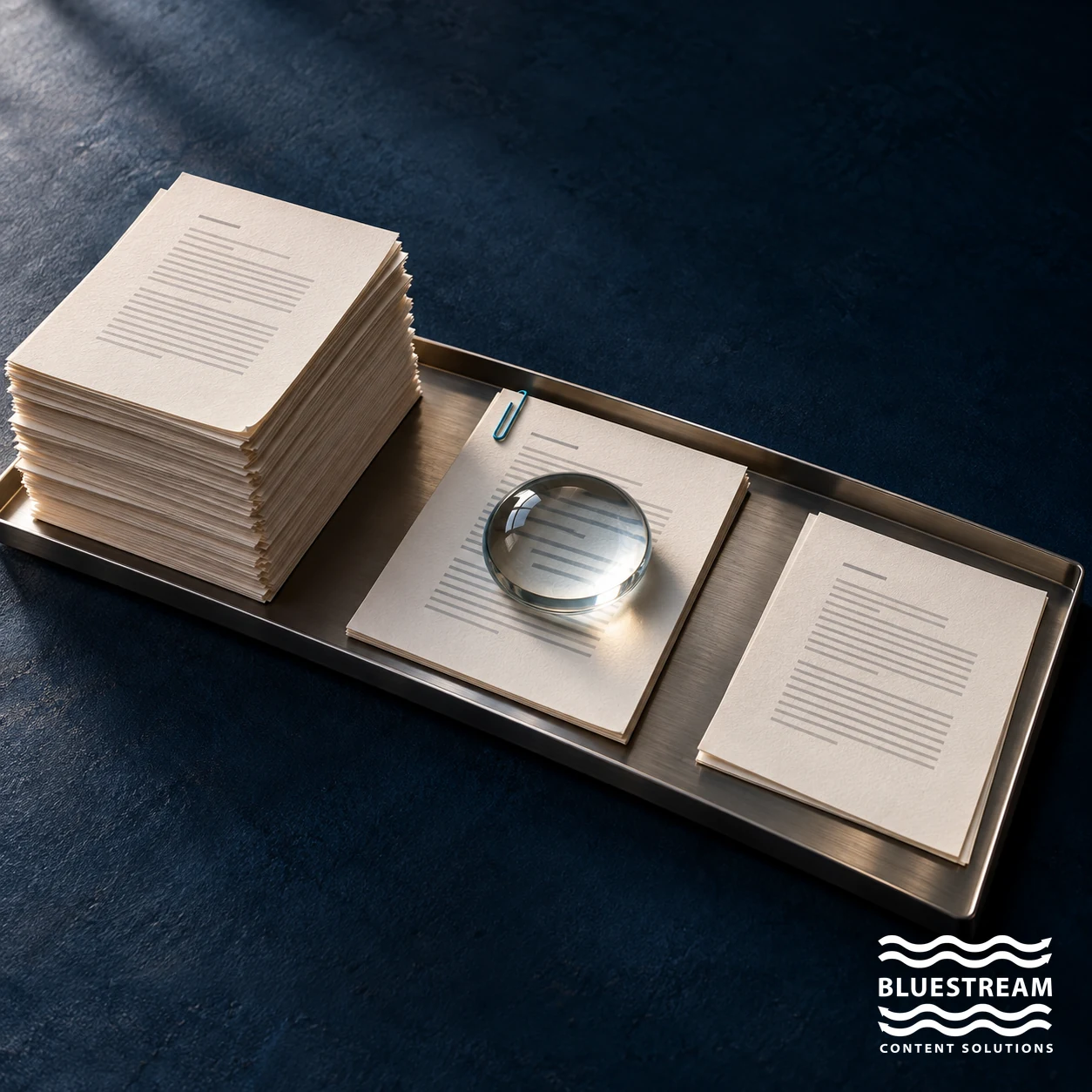
Manuscripts waiting in a review tray, illustrating a documentation review bottleneck.

Map the workRemove delaysMeasure quality

Documentation bottlenecks develop when work waits between authoring, review, release and delivery. The most useful first step is to trace a real update through those stages, separate writing time from waiting time, and fix the constraint that repeatedly delays approved information reaching users.

Technical writers can be busy throughout a release and still struggle to publish on time. Product changes arrive late, feedback is scattered, reused paragraphs have become separate copies, and publishing requires several manual handoffs. Asking writers to produce more content does little to resolve those problems.

A better approach is to examine how content moves. This guide explains the common points of friction, the evidence to collect, and the changes a documentation team can test before committing to a larger process or platform overhaul.

Start by mapping one documentation change

Choose a recently released procedure, service bulletin or help topic. Record when the team learned about the change, when a draft was ready, when each reviewer responded, when approval was given, and when the correct version became available to users. Include translation and publication checks where they apply.

This simple timeline distinguishes active work from queue time. A topic that takes several days to release may need little actual writing but spend most of its life waiting for a decision. Alternatively, a quick review can conceal a lengthy export, formatting and upload process. The remedy depends on which constraint the evidence reveals.

Where disconnected tools interrupt the flow

Authoring, review and delivery do not have to happen in one application. They do need a reliable way to pass content, status and ownership between systems. Manual exports and repeated uploads create opportunities for the approved version to diverge from the version users see.

Look for steps that require a writer to rename files, reconcile comments, rebuild formatting or check several portals by hand. Give each handoff an owner and a clear completion condition. For example, “published” should mean the approved revision is accessible in the intended channel and its links and attachments work, rather than merely that an export finished.

Before replacing tools, test whether a smaller change resolves the problem. A consistent release manifest, a supported integration or an automated link check may remove a recurring delay. If the remaining work requires component-level control across many outputs, assess whether a DITA component content management system fits that requirement.

Make review responsibilities visible

Review stalls when nobody knows whose decision is needed, which version is under review or what a reviewer is being asked to verify. Comments arriving through email, chat and separate files can also conflict. Writers then become coordinators of feedback rather than editors of a stable source.

Assign a named reviewer to each type of decision. Engineering may verify a procedure, product management may confirm applicability, and another authorized reviewer may assess a safety or legal issue. These responsibilities should be explicit; they should not be inferred from who happens to respond first.

Give reviewers a bounded question and a deadline appropriate to the release. Show what changed and preserve unresolved comments with their disposition. Parallel review can help where decisions are independent, but dependencies still need an order. A missed review should trigger an agreed escalation, not an assumption that silence means approval.

Replace duplicated text with managed reuse

Copying a warning into several manuals creates several maintenance obligations. When the warning changes, somebody must find every copy and determine which publications need a new release. That is duplication, even if the copied wording began identically.

DITA offers a different foundation. Its topic model supports units of information that can be organized and reused in different contexts. Reuse still needs editorial judgment: a shared instruction must remain correct for every product and audience that uses it.

Begin with content that genuinely stays the same across deliverables. Give it a clear owner, establish how changes affect dependent publications, and review it in context. Avoid forcing superficially similar procedures into one shared component when their prerequisites, hazards or configurations differ.

Treat findability as part of publication

A published answer is useful only if the intended reader can locate and recognize it. A document title may make sense to its author while a technician searches for an error code, symptom or part number. Inconsistent terminology and missing product metadata can turn a successful release into more support work.

Use support questions and search terms to improve titles, synonyms and metadata. Check whether a reader can distinguish the current procedure from an obsolete one and identify the product configuration it covers. Keep a route from a specific answer to the wider instructions when a task depends on prerequisites or safety information.

A centralized portal such as XDelivery can bring multiple content formats together with metadata filters, full-text search and access permissions. The underlying content and metadata still need to be accurate and maintained.

Bring documentation into change planning

Late product changes become especially disruptive when documentation impact is discovered only at the end of a release. Include documentation in change assessment early enough to identify affected topics, diagrams, translations and delivery channels.

Define what makes a change ready for a writer: an identified product revision, an explanation of the change, and access to a person who can verify it. Define what makes it ready to publish too. An urgent correction still needs the checks appropriate to its consequences, even when the release process is streamlined.

Plan for both scheduled releases and smaller corrections. The ability to update a topic independently is valuable only when related content, versions and approvals remain consistent. A faster publishing button cannot make an unreviewed procedure reliable.

Measure the delay you are trying to remove

Track a small set of measures for comparable work. Useful starting points are elapsed time from accepted request to publication, time waiting for review, the number of feedback rounds, and the number of corrections required after release. Explain what is included in each measure so comparisons stay meaningful.

Combine workflow measures with reader evidence. Search failures, recurring support questions and feedback on specific topics can reveal problems that publishing speed alone misses. Low page traffic is ambiguous: it may indicate low demand, poor findability or a task readers cannot access.

For a first improvement cycle, choose one recurring constraint, make one bounded change, and compare similar work before and after. Retain quality checks. The objective is a shorter, more reliable path to a usable answer, rather than a larger volume of content.

A practical first improvement cycle

  1. Choose a representative change. Trace one update across writing, review, translation and delivery.
  2. Identify the repeated delay. Use timestamps and reviewer feedback to distinguish a one-off event from a recurring constraint.
  3. Assign ownership. Give the constrained step a responsible person and a clear definition of done.
  4. Test a focused remedy. Improve the review request, replace a manual handoff or manage one reusable component.
  5. Check both speed and quality. Confirm that the released answer is accurate, findable and appropriate for its audience.

For the next stage, see using DITA for content migration and connecting documentation improvements with support outcomes. Teams reviewing authoring options can also consult our technical-writing tools overview.

Frequently asked questions

What is a documentation bottleneck?

It is a stage that limits the flow of documentation work, such as a review queue, a repeated formatting step or a publishing dependency. Find it by tracing actual work rather than assuming that writing is the slowest stage.

Why do technical writers encounter bottlenecks?

Documentation depends on product information, specialist decisions and delivery systems. Delays arise when those dependencies have unclear ownership or require repeated manual coordination.

Are bottlenecks caused by writers or tools?

Either capacity or process may contribute. Examine workload, source readiness, review queues and tool handoffs before choosing a remedy. A tool change will not resolve an unavailable reviewer or an undefined approval decision.

How do review and approval processes slow documentation?

Scattered comments, conflicting versions and unclear review responsibilities create waiting and rework. One review source, explicit decision owners and visible status make the process easier to manage.

Why can content reuse become difficult to maintain?

Copied content requires separate updates wherever it appears. Managed reuse reduces that duplication, but shared content still needs applicability checks and impact analysis when it changes.

How does poor findability create more work?

Readers who cannot locate an answer may contact support or the documentation team. Those requests provide useful evidence of missing terms, unclear navigation or gaps in the content.

What role do analytics play?

Analytics help identify repeated searches, unsuccessful journeys and heavily used topics. Combine them with user feedback and support records before deciding what to improve.

Where should a team start?

Map one recent change and identify its longest repeated delay. Test an improvement at that step before expanding the programme.

Can better tools eliminate every bottleneck?

No. Tools can reduce manual work and improve visibility, but teams still need reliable product information, reviewer capacity and clear responsibility for content quality.

Discuss your documentation workflow

Bring a real update, its review history and its delivery requirements to a conversation with Bluestream. We can discuss where XDocs and XDelivery fit your authoring, review and delivery workflow.

Contact Us

Sign-up for the latest Bluestream News

Close