


A theoretical automotive scenario
One content source.
Many vehicle experiences.
Optimizing the documentation production process for cost-effective, personalized user experiences.
Personalized automotive documentation uses structured, reusable content modules and vehicle configuration data to assemble the right information for each owner or technician. The same content can support manuals, online portals, in-car screens, companion apps, and service instructions.
By Rahel Anne Bailie · October 8, 2026
The multiplicity of automotive documentation
The automotive industry produces a huge amount of content related to the production of vehicles. Much of this is product information, such as owner’s manuals and service manuals, with relevant information and necessary instructions. This includes descriptions of any special conditions or restrictions on the use of the vehicle, its systems, components, and equipment.
As vehicles become more sophisticated, the amount of related documentation grows. So, too, does the number of potential variants as online configuration tools allow buyers to customize vehicles. Multiply these variants by geographic market and language, and the documentation threatens to be as complicated as the vehicle itself.
The height of efficient automotive documentation production
The ideal solution would be to create one superset of content assets and leverage those assets across multiple outputs. When those assets are produced as reusable content objects, their assembly into personalized output sets can be automated, including documentation for owners and post-sales repairs. A component content management system (CCMS) supports this content reuse by managing the modules centrally.
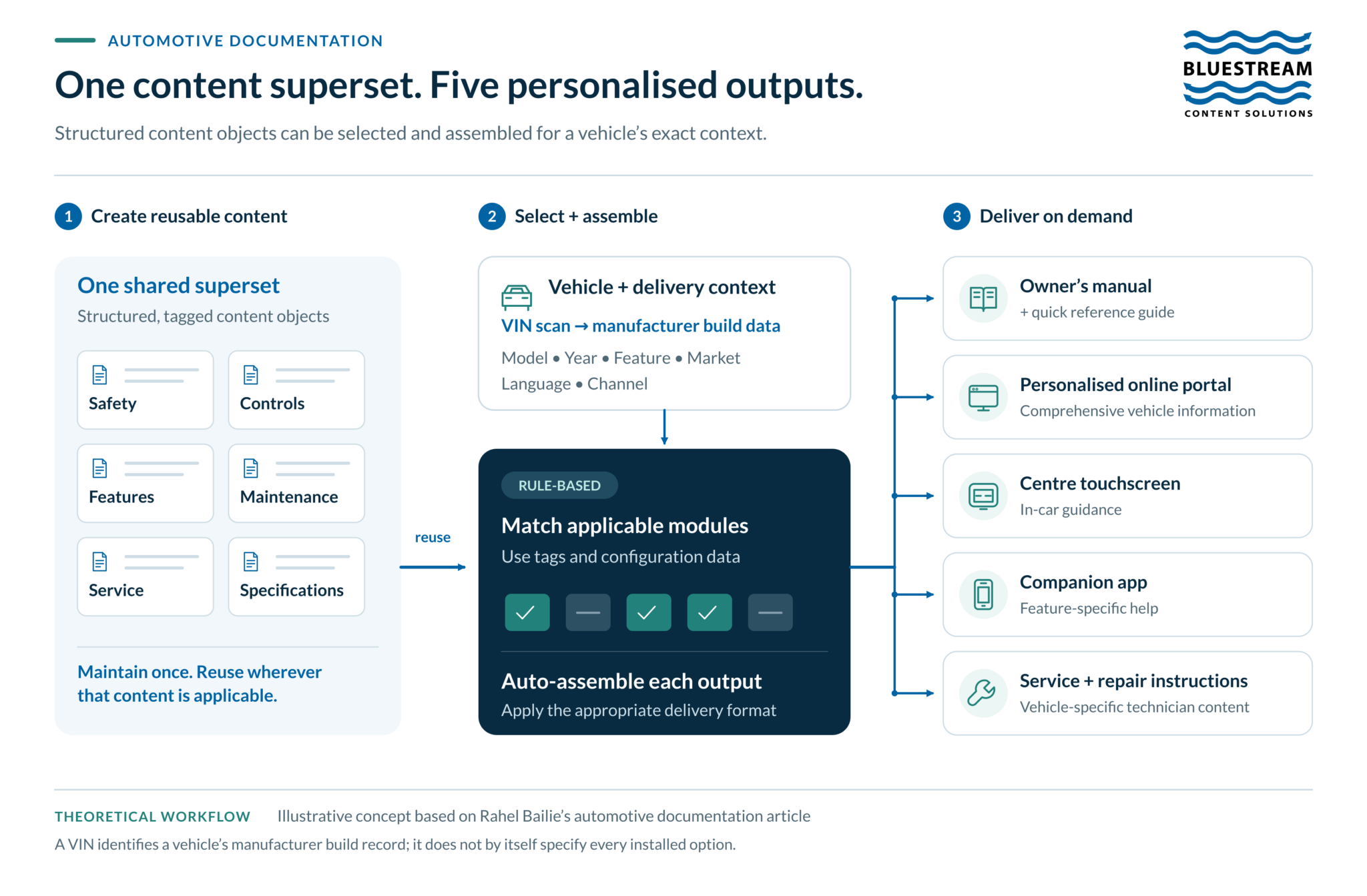
The principles behind this production method are available today, though the automotive workflow described here is a theoretical example. The advantage of producing content with this method is twofold. First, it can help solve the immediate capacity problem, allowing teams involved in producing product knowledge to deliver content at pace with the automobiles themselves. The second advantage is that the content is better prepared for future uses. When a new output is anticipated, such as an augmented reality app or an AI-enabled purpose, the structured content provides a foundation for that new application.
How can a VIN trigger personalized content assembly?
This is what a high-efficiency operating model could look like in practice.
As each automobile comes off the assembly line, the Vehicle Identification Number (VIN) is scanned. Scanning the VIN triggers a chain of content assembly by retrieving the manufacturer’s vehicle build record. This tells the content system which features are in the vehicle: transmission type, whether or not the vehicle has heated seats, a backup camera, and so on. The VIN is the lookup key; the build record supplies the detailed configuration. The content system pulls the relevant content modules from a central repository and assembles them into the various personalized outputs:
- Owner’s Manual. A one-off manual, assembled specifically for that vehicle’s configuration, that can be printed, alongside a personalised Quick Reference Guide. The manual reflects the exact specifications for that specific vehicle. Alongside any print version required for the relevant market, PDF versions may be offered as a way of providing updated information that could be printed to replace specific pages.
- A personalized online portal. The buyer gets a web login tied to their VIN, with comprehensive, personalised vehicle information. The information can be updated as approved changes are released.
- Centre screen. A subset of the information populates the centre screen, so drivers get in-car guidance matched to their actual vehicle. The specific variant may have sentences shortened to phrases, or perhaps simply an icon that is shown during a specific fault.
- A companion app. An augmented reality app, used on a mobile phone, could pull the relevant content dynamically when the user points the phone at an unfamiliar control, providing a feature name and brief instruction on its use.
- Repair and troubleshooting information. In-depth service and repair instructions for a particular vehicle, identified by a VIN. Meant for service and repair shops, and provided as independent content modules that can be printed for use.
These five outputs illustrate the range of information that automotive documentation can support. With suitable vehicle-data integrations, validation, and permissions, future-facing automotive companies could take advantage of the already structured and tagged content to provide new services, such as:
- Real-time updates of the centre screen. The centre screen content could be updated on an ongoing basis, notifying the driver of feature changes, recalls, or clarified instructions.
- Real-time diagnostics. The vehicle could be monitored while the car is being driven. Some faults could be detected and the driver notified before a problem becomes a breakdown.
- Periodic vehicle health checks. Connected vehicles could get automated health checks. For fleets such as car-share vehicles, monitoring could run continuously rather than on a schedule. The service could notify each new driver of potential problems before they begin driving.
- Service reminders. The monitoring system could assess vehicle wear-and-tear, identify developing faults, and push notifications to the driver, or even directly to an authorised, designated mechanic, allowing for parts to be ordered in advance.
The content for these outputs can come from the same repository. Connected services combine this definitive content source with real-time vehicle data and application logic to serve many destinations.
VIN DATA: WHAT THE SOURCE ESTABLISHES
NHTSA explains that a VIN encodes specific vehicle information and that its decoder uses manufacturer-reported data. In this theoretical workflow, the manufacturer’s build record supplies the detailed equipment configuration.
Source: NHTSA, VIN Decoder
Business opportunities and operational efficiencies
The automotive industry has begun to recognize that content can be used as a valuable business asset, and that smart use of those assets can create a competitive advantage. Simultaneously, while the amount of content grows in proportion to the number of makes and models being offered, the cost of content production, along with the production time, can be reduced.
The business opportunities related to more sophisticated use of content can be summarized as better customer experience and getting the right content to the right audience. Owners get information specific to their car, not a manual bulked out with sections on models they don’t own and features they didn’t choose. Owners, technicians, and fleet operators each get a version built for what they actually need to do, available on demand.
On the content operations side, automating the orchestration of the output takes the technical communication team off the treadmill of manually creating documentation. The focus of the content team goes into architecting and maintaining the modules that generate the outputs and deliver them to downstream applications. Content can grow in reach without a matching increase in manual effort.
Q&A: Personalized automotive documentation
How does a VIN identify the right documentation?
In this theoretical model, the VIN is the lookup key for the manufacturer’s vehicle build record. That record supplies the configuration used to select the relevant content modules. The VIN alone does not describe every installed option; the workflow depends on accurate build data and content tags.
How can shared content support different vehicle configurations?
A module can be reused wherever the same component or feature applies. Tags identify the relevant models, years, features, markets, languages, and output types. Assembly rules select the applicable modules, so owners and technicians receive information for their particular vehicle without a separate document being written for every configuration.
What should be checked before using this content in AI tools?
Check that the source modules are accurate, current, correctly tagged, and approved for the intended use. Confirm access permissions and how the AI service handles confidential or personal data. Test generated answers against authoritative documentation, verify their sources, and have qualified reviewers check safety-critical guidance. Structured content provides a foundation; it does not guarantee accurate AI answers.
Source: NIST, Generative AI Profile (2024).
Explore automotive and manufacturing documentation
Ready to deliver documentation for every vehicle configuration?
Give owners and technicians the information that fits their vehicle. Talk to Bluestream about how XDocs could help your team reuse approved content, manage variants and connect your documentation to the channels your customers use.
Tell us about your vehicle models, source systems and documentation goals. Let’s explore a workflow that fits your team.
Contact Bluestream
Use the form below to discuss your automotive documentation needs or arrange a demo.
