

CCMS investment planning

How to Build a Convincing Business Case for a CCMS

A presentation folder, calculator and organized documents illustrate building a CCMS business case.

Measure the baselineModel costs and benefitsValidate with a pilot

A convincing CCMS business case connects a documentation problem to a measurable business outcome. Leadership needs to understand what is costing time or money today, what will change, what the implementation requires, and how the organization will know whether it worked.

Start with a small number of defensible claims. A clear baseline and a conservative pilot are more persuasive than broad promises about translation savings, faster launches, or automatic compliance. The goal is an investment decision that remains credible after the system goes live.

1. Define the problem in business terms

Describe a consequence that stakeholders already recognize. Perhaps the team repeats the same update across several product manuals, delays a release while reconciling reviews, or struggles to reproduce the source behind an approved publication.

Make the statement specific enough to investigate. “Our content is inefficient” is hard to evaluate. “Every quarterly release requires manual reconciliation of the same procedure across twelve manuals” identifies a workflow, a frequency, and an opportunity to measure effort.

Connect the issue to the appropriate owner. Documentation may care about maintenance capacity, localization about packaging and translation spend, support about findability, and quality teams about release evidence. Avoid claiming that one platform investment will solve every stakeholder’s problem.
2. Establish a baseline and the cost of doing nothing

Follow representative work from request through release. Record hands-on effort separately from waiting time. Include the work performed outside the writing team, such as an engineer reconciling comments or a localization manager preparing files.

  • How many repeated edits occur in a typical release?
  • How long does it take to find the authoritative source and its uses?
  • How much review effort is spent checking unchanged or duplicate material?
  • What do translation invoices and supplier reports show about new, changed, and repeated content?
  • How much work is required to generate, inspect, and deliver each output?
  • Which defects or missed updates have been recorded, and what did correction require?

Use a normal sample as well as a difficult example. One unusually painful release can expose a problem, but it may not represent the annual workload. State the period and data source behind each baseline measure.

Describe the cost of continuing the current process without exaggerating it. Do not add hypothetical fines, revenue losses, or launch delays to the financial model unless the organization can support the causal relationship and assumptions.

3. Connect capabilities to testable outcomes

A capability is valuable when it changes the work. Component reuse may reduce repeated edits. A review workflow may reduce coordination. Release baselines may make approved content easier to reproduce. Localization management may reduce manual packaging and identify changed source more reliably.

The DITA conref mechanism, for example, provides a way to reference reusable content. That technical possibility does not establish a savings percentage. Your pilot must show how much genuinely reusable content exists and what effort the new management process removes or adds.

Write an acceptance test for each important benefit. If review time is the problem, run a real review with the actual reviewers. If localization packaging is the problem, send and return a representative package through the intended process. If release control is the problem, reproduce an approved publication and verify its dependencies.

4. Include the full cost of implementation

Budget for more than software. A CCMS implementation can require information architecture, content cleanup and conversion, integrations, publishing templates, training, migration validation, and internal project time.

Separate one-time costs from recurring costs. Recurring costs may include subscriptions, support, hosting, administration, and maintenance of custom configurations. Record assumptions about user numbers, growth, and the resources needed to keep the system useful.

Allow for a transition period. Authors may initially work more slowly while learning the model, and some legacy material may remain in its previous workflow. Agree who owns the implementation and which work will be deferred so the team has time to deliver it.

5. Use a transparent ROI model

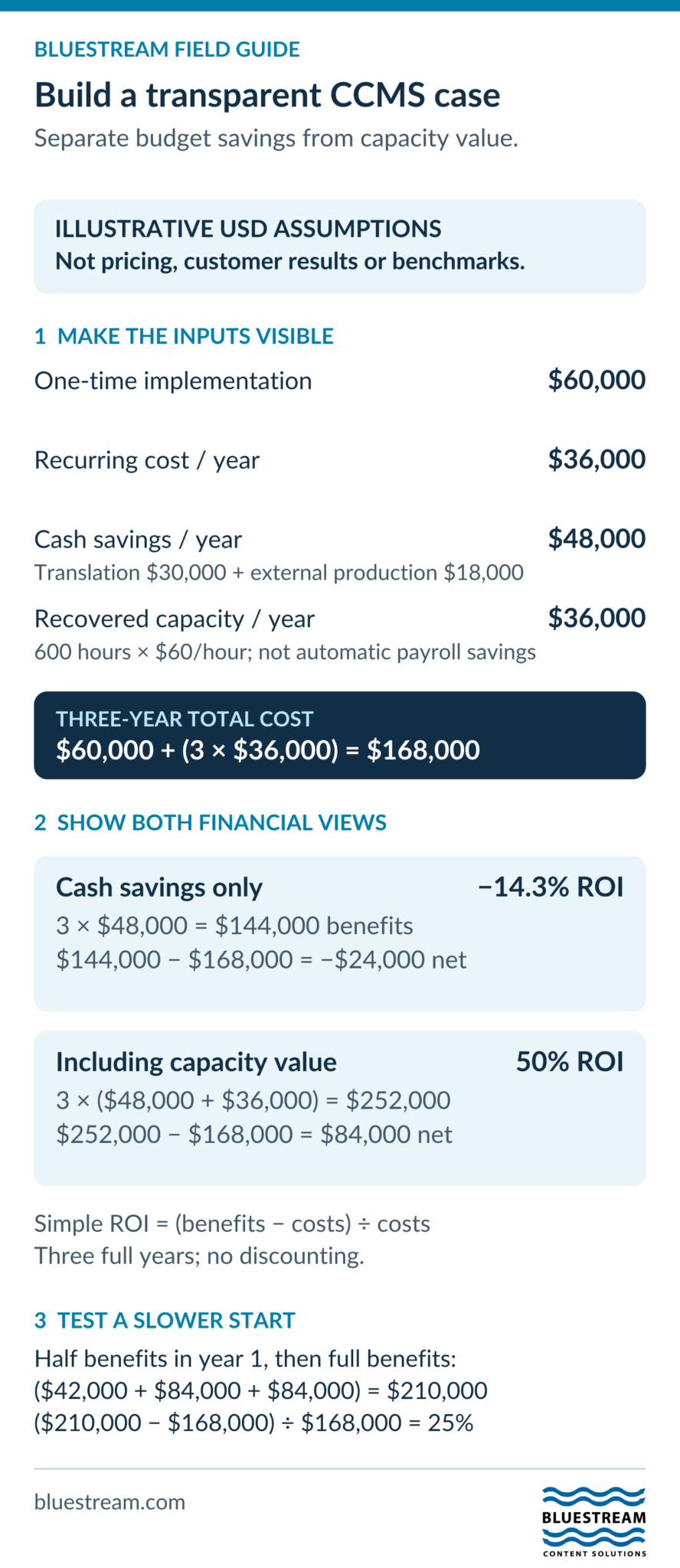
The following example is entirely illustrative. These amounts are fictional assumptions, expressed in USD; they are not Bluestream pricing, customer results, or industry benchmarks.

Over three full years, the total cost is $168,000: $60,000 plus three years at $36,000. The projected cash savings are $144,000: three years at $48,000. On cash savings alone, the net result is negative $24,000 and the simple three-year ROI is approximately negative 14.3%.

If the organization also accepts the $36,000 annual value of recovered internal capacity, total benefits become $252,000 over three years. The net economic benefit is $84,000, giving a simple ROI of 50%: net benefit divided by total cost.

These are two views of the same proposal, not interchangeable conclusions. Recovered writing hours do not automatically reduce payroll. Show how the capacity will be used, such as maintaining an additional product line, and keep it separate from budget savings.

Now test adoption risk. If only half the projected benefits are achieved in year one, followed by full benefits in years two and three, cash savings fall to $120,000. Total economic benefits become $210,000, producing a 25% economic ROI against the same $168,000 cost. That scenario shows how timing changes the decision.

Use the organization’s preferred financial method for a real proposal, including discounting or other adjustments where required. The example above is a simple undiscounted model designed to make assumptions visible.

Illustrative cost and benefit model

Illustrative three-year CCMS cost model separates cash savings from recovered capacity: cash ROI −14.3%, economic ROI 50%.
Illustrative USD assumptions from the article. Recovered staff capacity is separate from cash savings; the simple model is undiscounted.
Text version of this visual

Illustrative CCMS business-case arithmetic in USD, not Bluestream prices or customer results. One-time implementation is 60000, annual recurring cost 36000, annual cash savings 48000 comprising translation 30000 and external production 18000. Recovered capacity is 600 hours times 60 dollars, or 36000 annually. Three-year total cost 168000. Cash-only benefits 144000 minus costs yield minus 24000 and ROI minus 14.3 percent. Including capacity yields 252000 benefits, 84000 net economic benefit and 50 percent ROI. Half benefits in year one and full benefits in years two and three yield 210000 economic benefits and 25 percent ROI against the same cost. This is a simple undiscounted model.

6. Check for double counting and unsupported benefits

Do not count the same hour as authoring savings, publishing savings, and faster time to market. Assign each benefit to a defined activity and owner. If outsourced production costs fall because internal staff take on more work, include the additional internal effort.

Translation savings need similar discipline. Translation memory may already avoid charges for repeated segments. A CCMS may add value through packaging, version relationships, and reduced source duplication, but those effects must be distinguished from savings already achieved.

Keep quality, governance, and customer experience in the case even when they cannot be reliably monetized. State how you will measure them. A strong nonfinancial requirement is more credible than an invented dollar value.

7. Use customer evidence to shape the pilot

Bluestream’s Ricoh case study describes measuring routine actions and estimating the value of time saved across a writing team. The reported estimate belongs to that customer and implementation. Its useful lesson is the method: small repeated operations can be measured and aggregated with explicit assumptions.

Use case studies to identify questions, not to import another organization’s ROI. Ask what baseline, migration scope, content model, and training supported the result. Then determine which parts resemble your situation.

Keep an evidence record for every customer result you use. Name the organization, link the original case study, and identify who reported the result. Record the measured activity, comparison baseline, time period, implementation scope, and whether the figure is an observed result or an estimate. If the source leaves a detail unspecified, say so.

Then turn that evidence into a pilot question. For example: ‘How much hands-on time does our team spend finding, updating, reviewing, and releasing a reused procedure before and after the workflow change?’ Use the same content scope and acceptance checks in both measurements.

A customer result can help you choose what to test. Your own measurements establish whether the proposed benefit belongs in your business case.

End with a bounded decision

Ask for a defined next step: a workshop, a proof of concept, or a pilot covering one content set. State the budget, owner, scope, success criteria, and decision that will follow. Include conditions under which the organization should change the plan or stop.

A pilot for XDocs DITA CCMS should use the same content problems described in the business case. When the evidence shows a workable improvement, the larger investment decision becomes easier to defend.

Frequently asked questions

What is the most important part of a CCMS business case?

A defensible connection between the current problem, the proposed workflow change, and a measurable result. The baseline and pilot evidence matter more than the length of the feature list.

Should recovered staff time count as savings?

Show it as capacity value unless it produces a real budget reduction. Explain how the organization will use the recovered time and present cash savings separately.

Which costs are commonly missed?

Content cleanup, information architecture, migration validation, publishing templates, training, integrations, internal project time, and ongoing administration. Include the transition period and maintenance of custom work.

Can we use a standard translation-savings percentage?

Use your own supplier data and pilot results. The effect depends on existing translation memory, content reuse, source changes, pricing, and workflow. An unsupported industry percentage weakens the proposal.

How soon should we expect payback?

There is no universal timeline. Model when costs occur and benefits begin, include an adoption ramp, and test conservative assumptions. Some proposals are justified partly by capacity or control requirements rather than cash payback alone.

Contact Us

Sign-up for the latest Bluestream News

Close