

Industry use cases

How a CCMS Benefits Different Industries

A shared reference book beside a hard hat, reading glasses and luggage tag represents documentation across industries.

Identify shared needsTest industry workflowsMeasure the outcome

A CCMS can benefit very different industries for the same underlying reason: important information is reused across products, audiences, languages, and releases. When those relationships are managed through copied documents, each update creates another opportunity for content to diverge.

A Component Content Management System gives teams a way to manage reusable information and its lifecycle. The strongest business case comes from specific operational needs, such as keeping a service procedure aligned with a product configuration or preserving the approved version of a policy. Industry labels alone do not determine whether a CCMS is the right fit.

The content challenges industries have in common

Organizations evaluating a CCMS often need a combination of component reuse, metadata, review workflows, version control, localization, and multichannel publishing. The OASIS DITA standard is one established structured-content model for bringing those capabilities together around topics and maps.

Each capability should serve a clear purpose. Metadata might distinguish a machine model from a software version. A review workflow might route a procedure to engineering and safety specialists. A release baseline might preserve the exact instructions supplied with an older product. These decisions are part of the content strategy, not tasks the software can infer on its own.

The following examples show how the same management principles apply across six sectors, with different requirements and acceptance tests.
Learning and training: adapt content to the learner

Training teams often maintain overlapping material for different roles, regions, or product variants. A core explanation may appear in an instructor guide, a learner handout, a reference portal, and a refresher course. Subject matter experts supply knowledge while instructional designers and writers shape the learning experience.

A component-based approach can keep shared explanations and procedures aligned while allowing each deliverable to have its own organization. Metadata and publication rules can help select the appropriate audience or regional content. Browser-based contribution can make it easier for occasional experts to participate in review.

The practical test is whether shared content still works in each learning context. Reusing a maintenance procedure does not automatically create a complete lesson. Learning objectives, examples, practice, assessment, and accessibility may require separate design work. If delivery involves an LMS, confirm the integration and required packaging rather than assuming that every publishing output is a course.

Transportation: maintain controlled operational information

Transportation organizations manage procedures, policies, training, and technical information across changing fleets, equipment, and operating conditions. The challenge often includes proving which version was approved, what changed, and which audience should receive the update.

A CCMS can support that work through templates, version histories, metadata, review states, and release reporting. For example, a policy owner can revise a shared procedure while the currently approved publication remains available to operational users. Reviewers can inspect affected components and the resulting publication before release.

Evaluation should involve the people responsible for document control and applicable requirements. Ask them to specify the evidence they need, then demonstrate its production and retention. The system supports the controlled process; compliance still depends on the organization’s procedures, configuration, validation where required, and actual use.

Automotive: manage product and market variants

Owner information and service documentation may vary by model, powertrain, installed option, market, and language. Much of the information is shared, but some differences have significant consequences for the reader. A copied manual can make those differences difficult to track.

A CCMS can help organize common topics and variant-specific content, with publication rules that select the intended material. It can also support localization and review by engineering specialists. The goal is a traceable relationship between a product configuration and the instructions delivered for it.

Test a realistic pair of variants, including a procedure that looks similar but differs in a safety-critical step. Confirm how authors see the difference and how publishers prevent the wrong combination. If information will appear on an in-vehicle display, validate that delivery path, navigation, and presentation separately. A correct source topic is only the beginning of a usable embedded experience.

Manufacturing: connect manuals and parts information

Manufacturers often need installation instructions, service manuals, and Illustrated Parts Catalogs for closely related equipment configurations. Parts information may originate in ERP or PLM systems, while illustrations come from engineering or CAD workflows. Maintaining those sources independently can create discrepancies between the instructions, the diagram, and the orderable part.

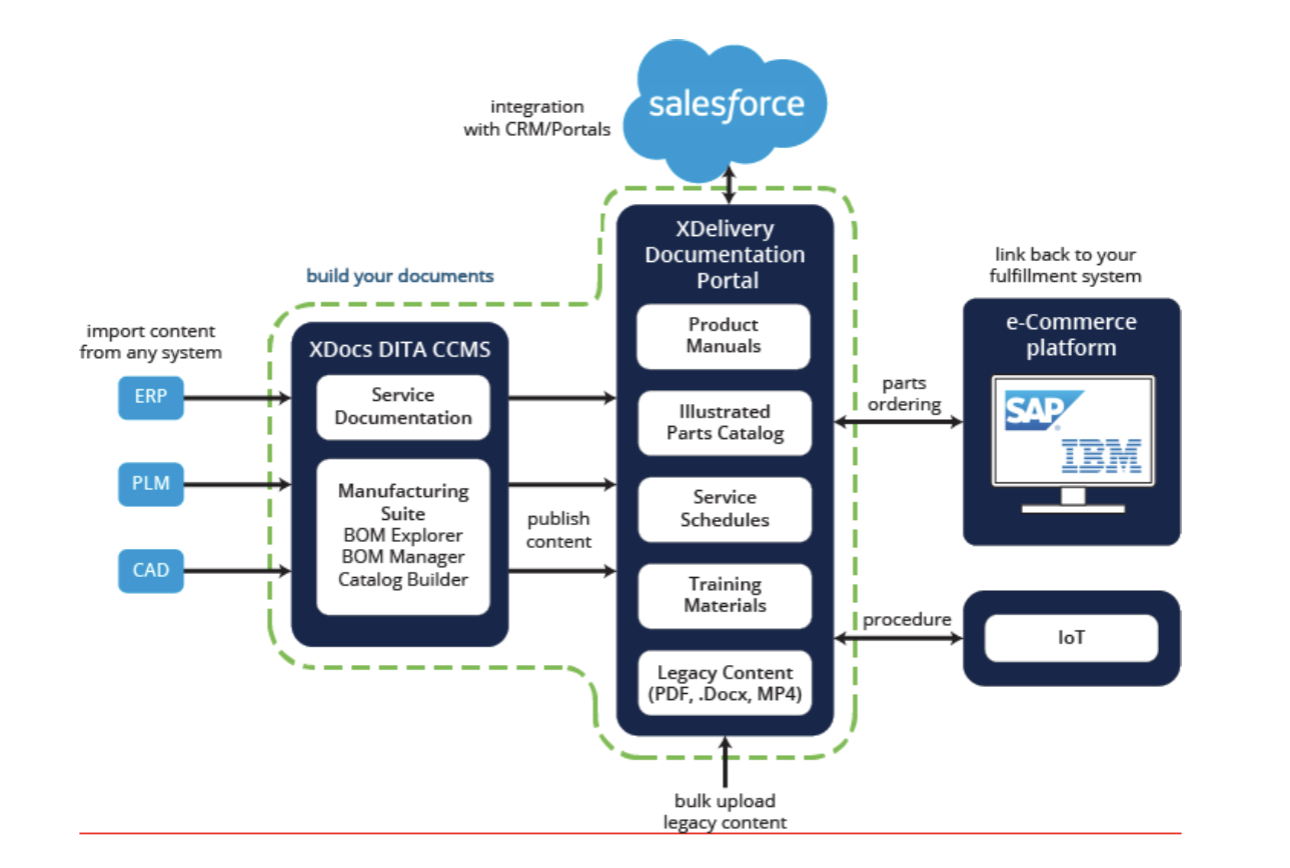
Bluestream’s XDocs Manufacturing Suite supports workflows that connect BOM data, technical illustrations, documentation, and IPCs. A suitable implementation can use those relationships to assemble configuration-specific information and support parts identification through a delivery portal.

ERP, PLM and CAD feed XDocs, which publishes manuals and illustrated parts catalogues to XDelivery; the example also shows CRM, parts ordering and IoT connections.
Illustrative manufacturing architecture from the original article. Each source, CRM, ordering, and IoT connection depends on the supported integration and project configuration.

Successful integration depends on agreed identifiers, source-system ownership, and rules for revisions and exceptions. Decide what happens when a part is superseded, a BOM changes, or an illustration is missing. A useful pilot follows one equipment configuration from its source data through the service procedure and parts catalog to the customer-facing output.

Measure outcomes such as time spent assembling a catalog, mismatched part references, or unsuccessful parts searches. Lower support effort and additional parts sales may be worthwhile goals, but they should be measured rather than presented as automatic results.

Medical technology: support rigorous content control

Medical technology documentation may combine frequent engineering changes, multilingual requirements, detailed approvals, and strict presentation needs. Even a small publications team can face a large web of shared content and dependencies.

The RefleXion case study describes a one-writer team managing about 20 publications, including six large user manuals. Its implementation combined DITA and XDocs with information architecture, tailored PDF output, training, and support. That context matters: the reported improvements were the result of a coordinated implementation, not simply installing an editor.

For a similar evaluation, identify the exact approval and release records your quality process needs. Test whether shared content, localized versions, and archived outputs remain traceable. Review applicable accessibility and regulatory requirements with qualified stakeholders. Structured authoring can make information easier to manage, but it does not independently establish conformity.

Networking OEMs: maintain parallel releases and brands

Networking manufacturers publish installation guides, configuration procedures, command references, and troubleshooting information for combinations of hardware and software. Older releases may remain supported while new features are being documented. Reseller branding can introduce another set of variants.

Several reuse strategies may be needed together. A shared topic can appear in multiple maps; conditional content can express a limited product difference; a branch can isolate a separately maintained release. Keys can help manage publication-specific names or references. The right choice depends on whether the difference is a variant within one release or an independently evolving content stream.

Ask vendors to demonstrate a correction that applies to two supported releases but not a third. Then publish one branded variant and check its names, links, commands, and product applicability. This exposes the everyday complexity that a generic authoring demonstration can miss.

Evaluate the complete content lifecycle

Start with the work your team needs to improve: creating, finding, updating, reviewing, translating, releasing, or delivering information. Describe the current difficulty and the desired outcome. Avoid reproducing every manual step from the old process simply because it is familiar.

  • Choose a representative publication with meaningful reuse and variation.
  • Include the actual authors, reviewers, administrators, and localization partners.
  • Test an update through approval and publication, including a failure or rejected change.
  • Inspect the final outputs and the evidence retained about their source.
  • Compare the effort and quality with the baseline, including implementation costs.

XDocs DITA CCMS brings content lifecycle capabilities together for teams with these needs. Bluestream’s customer case studies provide examples to investigate, while a demonstration using your own material establishes how the approach fits your organization.

Frequently asked questions

Which industries benefit most from a CCMS?

Benefit depends on content complexity more than industry size. Strong candidates have repeated information, multiple variants or languages, controlled releases, and several contributors. Manufacturing, technology, transportation, and medical-device teams often encounter that combination.

Can a small documentation team justify a CCMS?

Yes, when a small team manages demanding content relationships. Compare the cost of the system and implementation with the actual maintenance burden. A one-writer team with many shared manuals may have a stronger case than a larger team producing unrelated documents.

Does a CCMS replace ERP, PLM, or an LMS?

Usually it has a different role. Business systems remain authoritative for their own data or learning workflows, while the CCMS manages structured content and its relationships. Define interfaces and ownership explicitly.

Does structured documentation guarantee compliance?

No. It can support controlled authoring, traceability, and reporting. Compliance depends on the applicable requirements and the complete process, including people, procedures, system configuration, validation where required, and release checks.

Contact Us

Sign-up for the latest Bluestream News

Close