

Connected manufacturing

How AI, CCMS, and PLM Are Converging in Modern Manufacturing

Three glass holders bring separate document rolls together beside one publication.

Product dataControlled contentTrusted answers

PLM, a CCMS and AI can work together by connecting authoritative product data to controlled documentation and then making approved information easier to retrieve. PLM supplies engineering context, the CCMS manages reusable explanations and procedures, and an AI-enabled delivery layer helps users find relevant answers. The integration succeeds when identifiers, ownership and release states remain clear across all three.

This is a practical architecture for connecting product knowledge. It does not require one system to replace the others, and it does not make every engineering change ready for immediate publication.

Give each system a defined responsibility

Product lifecycle management systems support product structures, engineering revisions and change processes. PTC’s PLM overview describes the role of trusted product information and collaboration across the lifecycle. In a particular organization, ownership may also be shared with ERP, CAD or service systems.

A CCMS manages the technical content users need to act on that information: concepts, procedures, warnings, troubleshooting and reference topics. Writers and subject-matter experts explain the task, validate the sequence and identify what the reader must know.

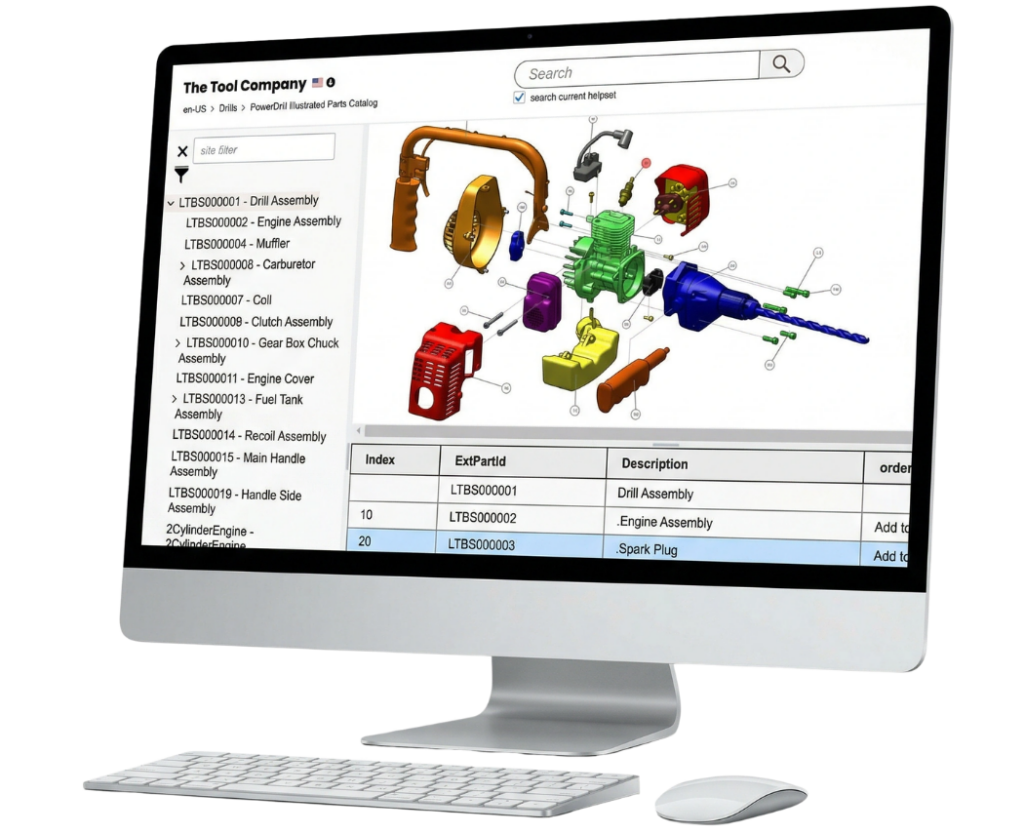
A delivery or retrieval layer selects content for the user’s product, role and question. An AI model may help summarize or phrase the answer, but it should remain connected to approved sources and the user’s access permissions.
XDocs DITA CCMS | Bluestream Content Solutions

Connect product data to documentation through stable identifiers

Reliable integration starts with shared references. A part, assembly, product configuration and content component need stable identifiers and explicit relationships. Display names alone are weak integration keys because names change and may be reused.

Define which system owns each field. Engineering may own a part revision; a documentation team may own a procedure’s wording and approval; a service organization may own the customer-facing support category. Copying data without preserving ownership can create competing versions of the same fact.

For a wider integration discussion, see how a manufacturing CCMS can connect with ERP and PLM systems.

Turn an engineering change into a controlled content change

Consider an illustrative case: a manufacturer approves a revised pump assembly. The integration identifies manuals, parts references and service topics linked to the changed assembly. The documentation team then determines whether the replacement procedure, warning, illustration or applicability needs revision.

The updated topics pass technical review and translation where needed. A release package records the product configuration and source versions. The delivery layer then publishes and indexes that approved package. An older machine can retain access to its applicable instructions.

The important step is impact assessment. A changed engineering field may require a content change, no change, or further investigation. Treating every source update as permission to regenerate and publish a procedure would skip that decision.

Use structured content to preserve meaning

DITA’s XML-based topic architecture supports content with a clear purpose, such as a task or reference topic. A CCMS can manage reuse and relationships so that related warnings, prerequisites and parts information stay connected.

Metadata should describe product applicability, language, lifecycle status and ownership in terms both the content system and delivery system can use. Structure helps only if these fields survive export and indexing. A portal that receives the text but loses the configuration constraints can still return an inappropriate answer.

Where AI can add value

AI can assist with activities such as identifying candidate content affected by a change, suggesting metadata, drafting an explanation from approved source material or interpreting a user’s question. These are distinct use cases with different review and permission needs.

For user-facing retrieval, a question should first be matched to the correct product context and authorized sources. The answer should cite those sources, retain important qualifications and provide access to the full approved procedure.

AI can make mistakes even when the content is well structured. NIST’s Generative AI Profile identifies confabulation as a risk to manage. Validate retrieval and generated responses rather than assuming that connecting systems guarantees accuracy.

Keep safety and access controls throughout the flow

Permissions must apply to exports, indexes and answer generation, as well as the source repository. A user’s role in a portal should not inadvertently reveal internal engineering notes through search snippets or generated summaries.

For safety-critical tasks, keep prerequisites and warnings attached to the instructions. When product context is incomplete, ask for clarification. When approved evidence is missing, provide an escalation path instead of a plausible repair sequence.

Record the content version used by the answer where appropriate, and define what happens when a source is withdrawn or corrected.

Plan for integration failures

Connected systems can drift apart. An import may fail, a product identifier may change, a translation may lag behind, or an index may still expose a retired topic. Define monitoring and recovery responsibilities before relying on the integration for daily support.

  • Validate required identifiers and applicability fields at each boundary.
  • Distinguish draft, approved and released states consistently.
  • Report failed or partial transfers without silently publishing incomplete data.
  • Test withdrawal, rollback and reindexing behavior.
  • Reconcile the delivered content with the intended release package.

Start with a bounded product workflow

Choose one product family and a recurring service use case. Map the source data, affected content, review steps and delivery channels. Include a normal change, a rejected change and an urgent correction in the pilot.

Measure change-impact coverage, correction lead time, release consistency and the ability of users to find the applicable answer. Those results show whether the integration is useful before expanding to more products or more autonomous actions.

Frequently asked questions

What does a CCMS do in manufacturing?

It manages reusable documentation components and their versions, relationships and releases. It connects product facts to reviewed explanations and procedures for users.

Why combine it with PLM?

Linking product changes to content helps teams identify affected documentation and maintain applicability. The exact integration depends on which systems own the product and service data.

How does a CCMS support AI and search?

It can provide clear topic boundaries, metadata and approved content versions. The retrieval system must actually use those inputs, and its answers still need evaluation.

What are the benefits of structured content?

It supports reuse across manuals and training, consistent relationships and publishing to multiple formats. Those benefits rely on deliberate modeling and release controls.

Can this architecture manage product variants?

Yes, when variant identifiers and conditions are mapped consistently across systems. Test the published result for each supported configuration.

Is this only practical for large manufacturers?

No, but the value should justify the integration and maintenance effort. Smaller teams can begin with a narrow use case rather than connecting every system at once.

Connect one useful workflow first

Bring engineering, documentation and service owners together around a real product change. Bluestream’s XDocs Manufacturing Suite can be evaluated as part of the content workflow, alongside the identifiers, controls and delivery requirements you define.

Contact Us

Sign-up for the latest Bluestream News

Close