

Documentation teams are under pressure to produce more content, update it faster, and deliver it across more channels than ever before. Product releases move quickly, engineering changes happen continuously, and users expect accurate answers immediately.
Traditional documentation workflows were not designed for this pace. They often depend on manual handoffs, repeated formatting work, disconnected source systems, and late-stage reviews. As content volume grows, these workflows become harder to sustain. Agentic AI introduces a new way to think about documentation production. Instead of using AI only to draft text or summarize content, agentic AI can support a connected workflow that moves documentation from source information to structured content, review, publishing, and delivery.
The result is not fully automated documentation without human oversight. It is a smarter production model where AI agents handle repeatable tasks, surface issues earlier, and help documentation teams focus on accuracy, clarity, and strategy.
What Is Agentic AI in Documentation?
Agentic AI refers to AI systems that can perform multi-step tasks with a defined goal. Instead of waiting for one prompt at a time, an agent can gather inputs, make decisions within set boundaries, trigger workflows, and complete tasks across connected systems. In documentation, this could mean an AI agent that monitors product changes, identifies affected topics, suggests updates, applies metadata, routes content for review, and prepares it for delivery.
The key difference is workflow. A standard AI tool may help write a paragraph. An agentic AI system can help manage the process around that paragraph.
Starting with Source Content
Documentation production begins with source information. This may come from engineering systems, PLM platforms, support tickets, product requirements, release notes, service data, or subject matter expert input.
In many organizations, this information is scattered. Technical writers must manually collect updates, interpret changes, and determine which documentation is affected.
Agentic AI can help by monitoring source systems and identifying documentation triggers. For example, when a product specification changes, an AI agent could flag related procedures, parts references, or configuration topics that may need review.
This reduces the risk of missed updates and gives documentation teams earlier visibility into change.
Turning Source Information into Structured Content
Once source information is identified, it must be transformed into usable documentation.
This is where structured authoring becomes critical. Agentic AI works best when content follows a clear structure, such as topic-based authoring or DITA. Structured content gives AI systems defined content types, relationships, metadata, and boundaries.
An AI agent could help convert raw product information into draft topics, suggest whether the content should be a procedure, concept, troubleshooting topic, or reference entry, and apply initial metadata based on product, audience, version, or region.
Human writers still validate the content, but the first stage of organization becomes faster and more consistent.
Automating Metadata and Classification
Metadata is often one of the most important but most neglected parts of documentation production. It determines how content is filtered, reused, searched, personalized, and delivered.
Agentic AI can support metadata creation by analyzing content and recommending tags. It can identify product names, version references, content type, audience, lifecycle status, and related topics.
This helps documentation teams maintain consistency across large content sets. It also prepares content for intelligent search, AI chatbots, documentation portals, and personalized delivery experiences.
Without metadata, automation quickly becomes unreliable. With metadata, agentic AI has the context it needs to make better workflow decisions.
Identifying Reuse and Reducing Duplication
Duplicate content is a common problem in documentation environments. Similar procedures, warnings, and reference sections are often copied across manuals or product lines.
Agentic AI can help detect duplication by comparing topics, identifying overlap, and suggesting reuse opportunities. Instead of creating another version of the same content, writers can reuse an existing approved topic or create a shared component.
This reduces maintenance effort and improves consistency. When content changes, teams update one source rather than chasing multiple copies across outputs.
For documentation teams managing complex products, this is one of the most practical benefits of agentic AI.
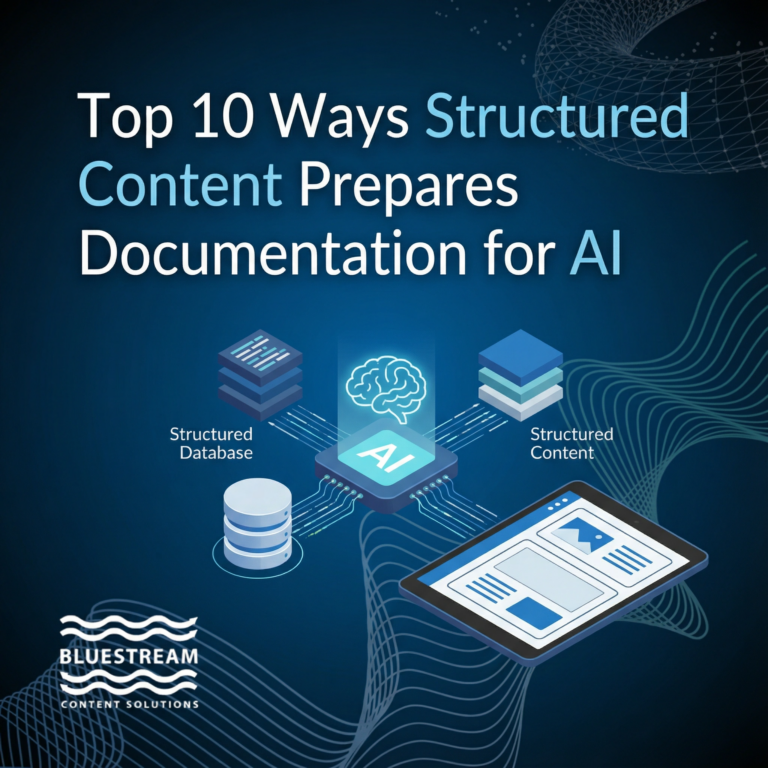
Discover how structured content enables AI-driven search, smarter documentation delivery, and better user experiences across complex manufacturing environments…
Supporting Review and Approval Workflows
Review cycles are often slow because subject matter experts are asked to review too much content at once. They may receive full documents when only a few topics have changed.
Agentic AI can make review more targeted. It can identify what changed, which topics are affected, and who should review them based on metadata, ownership, or content type.
For example, safety content could be routed to a compliance reviewer, service procedures to a technical expert, and customer-facing release notes to a product owner.
This makes reviews more efficient and helps ensure the right people evaluate the right content.
Publishing Across Multiple Channels
Documentation is rarely delivered in one format. Teams may need to publish to PDFs, web portals, mobile views, embedded help, support sites, or AI-powered answer systems.
Agentic AI can help manage publishing rules and delivery workflows. Once content is approved, agents can trigger publishing to the correct channels based on audience, product, language, or release status.
This is especially valuable when documentation must be delivered quickly after a product update. Instead of manually coordinating outputs, teams can rely on governed workflows that publish the right content to the right destination.
Delivering Answers, Not Just Documents
The final stage of documentation production is delivery. Increasingly, users do not want to browse documents. They want direct answers.
Agentic AI can support intelligent delivery by connecting structured documentation to search systems, AI chatbots, and content delivery platforms. When content is well structured and approved, AI can retrieve relevant topics and present answers in a conversational or task-focused format.
This turns documentation from a static output into an active knowledge system. Users can ask questions, search by intent, and receive information that is relevant to their role or product context.
Using Analytics to Improve the Workflow
Agentic AI can also help close the loop after delivery.
Documentation analytics reveal how users interact with content. Search terms, failed queries, chatbot questions, page views, and support ticket patterns can show where documentation is unclear, missing, or difficult to find.
An agentic workflow can use this data to suggest improvements. If users repeatedly ask the same question, an AI agent could flag the relevant topic for review. If a search returns no useful result, the system could recommend new metadata or a new troubleshooting topic.
This creates a continuous improvement cycle where documentation evolves based on real usage.
Why Human Oversight Still Matters
Agentic AI can automate many steps, but documentation still requires human judgment.
Technical writers understand audience needs, safety implications, tone, clarity, and context. Subject matter experts validate accuracy. Documentation managers define governance and strategy.
The strongest agentic AI workflows keep humans in control while reducing repetitive work around them. AI can draft, classify, route, compare, and suggest. Humans approve, refine, and take responsibility for quality.
This balance is especially important in technical documentation, where accuracy and trust matter.
What This Looks Like in Practice
A practical agentic documentation workflow might begin with a product change in a source system. The AI agent detects the change, identifies affected documentation topics, suggests updates, applies metadata, and checks for reused content.
The updated topics are routed to the correct reviewers. Once approved, the system publishes them to the documentation portal, updates relevant outputs, and makes the content available to search and chatbot systems.
After publication, analytics monitor whether users are finding the updated information. If questions or failed searches appear, the workflow flags potential improvements.
This is documentation production as a connected system, not a series of disconnected manual tasks.
Final Thoughts
Agentic AI has the potential to transform documentation production from source to delivery. It can help teams identify changes earlier, structure content faster, reduce duplication, improve review cycles, automate publishing, and support intelligent answer delivery.
But agentic AI is most effective when it is built on strong documentation foundations. Structured content, metadata, governance, reusable components, and modern delivery platforms all matter.
The future of documentation production is not about replacing technical writers. It is about giving documentation teams smarter systems that help them keep pace with complexity, improve quality, and deliver better information faster.
Want to See Metadata Strategies in Action?
Want to see how a modern documentation portal can support Right to Repair and improve access to your technical content?
Explore how XDelivery helps manufacturers deliver structured, searchable, and AI-ready documentation across all products and user groups.
Q&A: Agentic AI and Documentation Production
What is agentic AI in documentation?
Agentic AI refers to AI systems that can complete multi-step documentation tasks, such as identifying content changes, suggesting updates, applying metadata, routing reviews, and preparing content for delivery.
Can agentic AI replace technical writers?
No. Agentic AI supports technical writers by automating repetitive tasks, but human expertise is still needed for accuracy, clarity, safety, and final approval.
How does agentic AI help with documentation updates?
It can monitor source systems, detect product changes, identify affected topics, and suggest updates so documentation teams can respond faster.
Why does structured content matter for agentic AI?
Structured content gives AI clear boundaries, topic types, metadata, and relationships. This makes automation more reliable and helps AI understand how content should be used.
How can agentic AI improve review workflows?
It can route content to the right reviewers based on metadata, ownership, or content type, reducing unnecessary review work and speeding up approvals.
Can agentic AI help with publishing?
Yes. Once content is approved, agentic AI can help trigger publishing to the correct channels, such as documentation portals, PDFs, mobile views, or chatbot systems.
What is the biggest benefit of agentic AI for documentation teams?
The biggest benefit is scalability. Agentic AI helps teams manage more updates, more content, and more delivery channels without relying entirely on manual processes.
