
Repair documentation

Right to Repair Readiness

A repair-readiness checklist beside a service booklet, pencil and hex key.

ScopePrepareVerify

Right to Repair readiness means understanding the repair-access obligations that apply to a product and market, then making the required information usable and maintainable. A documentation portal can support that work, but neither a portal nor a CCMS establishes legal compliance by itself.

Repair rules differ by jurisdiction, product category, date and audience. The overview below reflects official sources checked on 11 October 2026. Use it to organise a documentation readiness review with your legal, product and service teams, rather than as a legal determination for a particular product.

Right to Repair Is About More Than Parts

When people talk about Right to Repair, they often focus on whether users can buy replacement parts or access repair tools. But even with the right part in hand, a repair can still fail if the user cannot find the correct instructions.

Repair requires context. Users need to understand what the part does, how it fits into the system, what precautions apply, and which procedure should be followed. This is especially important in manufacturing environments where products are complex, configurable, and often safety-critical.

Documentation is what turns repair access into practical repair capability.
Why Documentation Access Matters

Manufacturers may already have repair documentation, service manuals, troubleshooting guides, and parts catalogues. The problem is that this information is often difficult to find or scattered across multiple systems.

If documentation is buried in large PDFs, stored in disconnected file repositories, or written only for internal experts, it may not support Right to Repair effectively.

Accessible repair documentation should be:

  • Easy to find
  • Accurate and current
  • Appropriate for the user’s role
  • Specific to the product or configuration
  • Clear enough to support safe repair

Availability alone is not enough. Documentation must be usable.

Right to Repair Readiness: Why Manufacturers Need a Documentation Strategy Now | For Manufacturers | Documentation | Image

The Challenge of Supporting Different Repair Audiences

Repair information may need to serve owners, independent repairers, authorised service organisations, dealers and internal teams. Their technical needs differ, but access decisions must follow the applicable law rather than simply mirror an existing dealer-only model.

A user may need a clear maintenance procedure while a professional repairer needs diagnostics, schematics or calibration information. Identify the required audience and information for each covered product. Where registration or qualification conditions are permitted, check that the process and response times meet the relevant requirements.

Design the experience so that a legitimate repairer can find the appropriate information without navigating internal terminology or unnecessary barriers. Test the journey using the account type and permissions that person would actually have.

Structured Documentation Makes Repair Information Scalable

Traditional documentation approaches often rely on large manuals and duplicated documents. This becomes difficult to manage when products have multiple models, variants, and regional requirements.

Structured documentation works differently. Content is created in smaller, reusable topics such as procedures, warnings, troubleshooting steps, and parts references. Metadata can then define where each topic applies.

This makes it easier to deliver the right repair information to the right audience without creating separate versions of every manual.

For example, a technically identical repair procedure can be reused across the models it applies to. Reviewed applicability rules and tested publishing profiles select the appropriate content for each configuration.

Why Metadata Is Critical for Right to Repair

Record the product model, revision, configuration, market, language and applicable service period for repair content. These fields help users select information for the equipment they own and help the manufacturer maintain older installed products.

Keep legal applicability and product applicability distinct. A procedure can be technically correct for a model while the rules governing who must receive it differ across markets. Maintain a reviewed access policy linked to the relevant requirement, then configure the portal accordingly.

Metadata is useful only if it remains accurate through publishing and search. Test superseded parts, legacy models and translated procedures; a “latest version” label does not tell a repairer whether the instructions fit an older machine.

Digital Portals Improve Repair Documentation Access

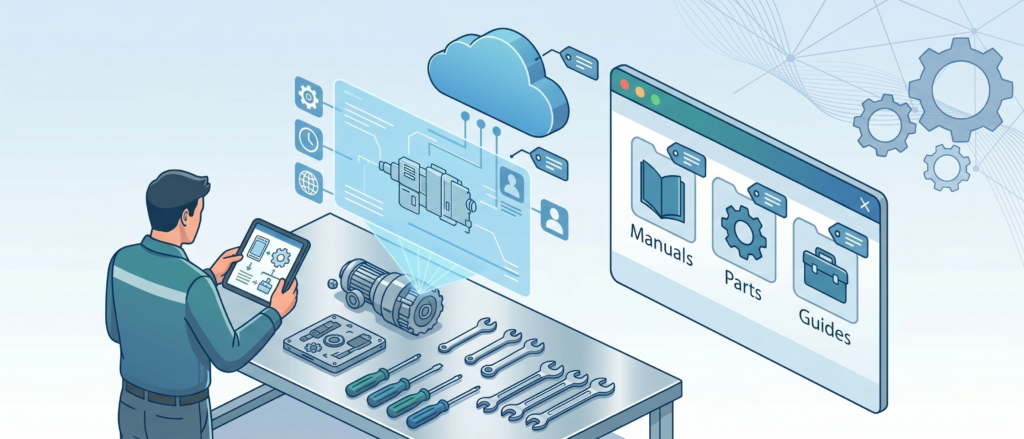
A self-service documentation portal can play a major role in Right to Repair readiness. Instead of forcing users to navigate disconnected files, a portal provides a centralized place to search, filter, and access repair information.

Modern documentation portals can support:

  • Product-specific navigation
  • Search by symptom, part number, or task
  • Role-based access
  • Mobile-friendly viewing
  • Links between procedures, parts, and warnings

This improves the user experience and reduces the risk of users following the wrong procedure or relying on outdated content.

AI Can Help Users Find the Right Repair Information

AI-assisted retrieval may connect plain-language symptoms to approved repair topics. It should first establish the product and configuration, enforce lawful access rules and link to the complete source. It must not invent a missing step, specification or permission to perform a repair.

Provide conventional search and navigation as dependable alternatives. A repairer should not need to persuade a chatbot to reveal information they are entitled to access. Evaluate generated answers for correct applicability and complete warnings, and direct uncertain or hazardous situations to the appropriate support process.

Right to Repair Also Requires Governance

Governance should make required access dependable while preserving accurate instructions and appropriate protections. Do not use a general claim about safety or intellectual property as a substitute for reviewing the actual legal requirement and any specific exception.

Assign owners for the repair content, access policy, product mapping and withdrawal process. Record what was released, which products and users it applied to and how a correction reaches users. Maintain older approved information for products still in service where the applicable requirements or support policy call for it.

A CCMS can help organise versions and approvals; a delivery portal can expose the resulting material. Compliance also depends on matters outside documentation software, such as parts, tools, terms, response times and the product’s repairability.

Documentation Teams Are Central to Right to Repair

Right to Repair is often seen as a legal, operational, or service issue. But documentation teams play a central role in making it work.

Technical writers and content teams are responsible for turning complex product knowledge into clear, usable repair information. They understand how to structure procedures, apply metadata, manage reuse, and write for different audiences.

As Right to Repair expectations grow, documentation teams will become even more important to product support strategy.

Start with the jurisdiction and product scope

In the European Union, the right-to-repair directive entered into force on 30 July 2024, with a deadline of 31 July 2026 for Member States to transpose the rules. The Council of the EU overview describes the relationship between these rules and product-specific ecodesign requirements.

The directive’s repair obligation is tied to goods covered by the repairability legislation listed in Annex II. It is not a universal obligation covering every industrial machine. Check the directive and its current amendments, the relevant product rules and national implementing law before deciding what must be supplied in a particular market.

For the United Kingdom, the official ecodesign guidance directs manufacturers to applicable product-specific regulations and distinguishes Great Britain from Northern Ireland. Do not assume that an EU requirement has identical coverage or application throughout the UK.

In the United States, state laws can have different product definitions, exclusions and conditions. Oregon’s SB 1596 is an example of legislation addressing access to documentation, tools and parts for covered consumer electronic equipment. It should not be treated as a nationwide rule or automatically applied to every manufacturing product.

Build a requirement register for the products you actually sell. Record the jurisdiction, covered models, relevant dates, required recipients, information and tools, access terms, retention or availability period, responsible owner and authoritative source. Have the interpretation reviewed before changing access controls.

Test one complete repair-information journey

Select a covered product and a realistic repair task. Start from the same public or registered entry point an owner or independent repairer would use, rather than from an internal shortcut. Confirm that the product can be identified and that required information can be found, opened and understood.

Check the procedure together with its warnings, parts references, illustrations, fault codes and required tools. Verify that part supersession or a changed serial range does not send the user to an incompatible instruction. If a document is downloadable, show its revision and explain how users obtain corrections.

Record failures as specific actions: a broken link, missing diagram, unavailable legacy model, inaccessible format or unjustified permission barrier. Assign an owner and retest the same journey after correction. This produces more useful readiness evidence than counting the number of PDFs in a portal.

Repeat the exercise for relevant audiences and markets. Review translated content and assistive-technology access where required, and provide a clear route for reporting missing or incorrect repair information.

A practical next step

Begin with a product-and-market scope review, then test whether an eligible user can complete a real information task. Keep the requirement register, content inventory and access configuration aligned as products and rules change.

Explore XDelivery for searchable, permission-controlled documentation delivery. Define the legal access requirements first, then evaluate how the solution should implement them.

Frequently asked questions

What does Right to Repair mean for manufacturers?

Depending on the product and jurisdiction, manufacturers may need to provide repair information, parts, tools or repair services on specified terms. Identify the applicable law and dates for each product rather than assuming one global rule.

Why is documentation important for Right to Repair?

Repairers need usable instructions, warnings, diagnostic information and product context. Making a file available does not by itself show that the required information is accessible or complete.

What kind of documentation supports Right to Repair?

Relevant material can include repair procedures, schematics, fault codes, parts catalogues, tool requirements and configuration details. The legally required set depends on the applicable product rules.

How can manufacturers make repair documentation easier to access?

Use clear product identification, searchable topics, maintained links and an access process designed for the legally entitled audience. Test that process from the repairer’s perspective.

Can AI help with Right to Repair documentation?

It can provide an additional way to locate information. Preserve conventional access, approved source links and product applicability; generated responses do not replace required documentation.

Why does governance matter for repair documentation?

It keeps content versions, access rules and corrections controlled. Governance supports compliance work but does not establish compliance without a product-specific legal assessment.

Contact Us

Sign-up for the latest Bluestream News

Close