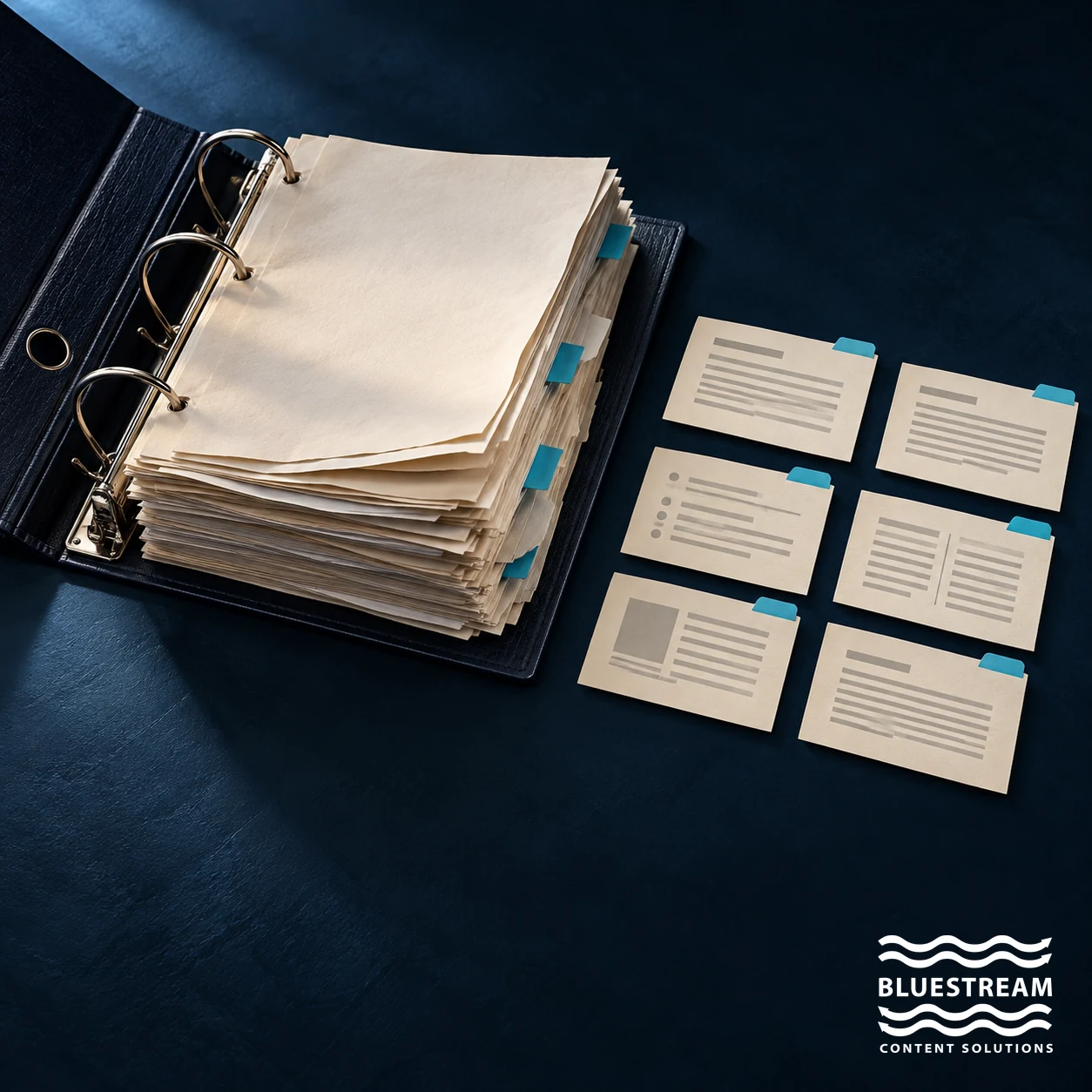
Technical documentation is not static text stored in files. It is information built from reusable components such as procedures, warnings, reference material, illustrations, and parts data. These components are often shared across multiple publications, products, and audiences.
File-based systems manage documents as containers, but they do not understand the content inside them. As a result, reuse becomes manual, updates are repeated across documents, and consistency becomes difficult to maintain.
DITA changes this by structuring documentation into topics. Each topic has a defined purpose and can be tagged with metadata. These topics can then be reused, filtered, and assembled into different outputs. XDelivery builds on this structured foundation to make documentation easier to manage and deliver at scale.
The Real Problem SharePoint Is Asked to Solve
When organizations say they want to “fix SharePoint,” what they usually mean is that documentation is hard to find, hard to maintain, and hard to trust.
- Files are duplicated.
- Versions conflict.
- Search returns too much or too little.
- No one is sure which document is current.
The assumption is that better folder structures, permissions, or naming conventions will fix the issue. In reality, these problems are symptoms of a deeper mismatch between file-based content management and documentation workflows.
One of the key advantages of DITA is its topic-based structure. Instead of maintaining large documents, documentation teams work with smaller, focused units of content that can be reused across multiple publications.
This approach allows teams to update content once and reflect that change everywhere it appears. It also supports conditional publishing for different audiences, products, or configurations. Metadata adds another layer of control, enabling documentation to be organized and retrieved intelligently.
XDelivery takes advantage of this structure by delivering content in ways that preserve relationships between topics, ensuring users always see accurate and relevant information.
Structured Content That Scales with Documentation Needs
One of the key advantages of DITA is its topic-based structure. Instead of maintaining large documents, documentation teams work with smaller, focused units of content that can be reused across multiple publications.
This approach allows teams to update content once and reflect that change everywhere it appears. It also supports conditional publishing for different audiences, products, or configurations. Metadata adds another layer of control, enabling documentation to be organized and retrieved intelligently.
XDelivery takes advantage of this structure by delivering content in ways that preserve relationships between topics, ensuring users always see accurate and relevant information.
Search Designed for Documentation Users
Users searching documentation are rarely looking for a document name. They are looking for answers, tasks, or specific information related to a product or process.
XDelivery uses structured DITA content to support search experiences that go beyond simple keyword matching. Content is indexed at the topic level, allowing users to retrieve precise results. Metadata supports filtering and narrowing results, while semantic search helps surface relevant information even when terminology varies.
The result is a documentation experience where users can find what they need quickly, without frustration.
Unified Delivery Across Formats and Audiences
Documentation must often be delivered in multiple formats, including web portals, PDFs, embedded help systems, and mobile-friendly views. Maintaining these outputs separately increases effort and introduces risk.
With structured DITA content, XDelivery enables a single-source approach. The same topics can be assembled into interactive web documentation, compiled into printable manuals, or embedded within support portals. This ensures consistency across channels and reduces duplication.
Documentation teams can focus on content quality rather than managing multiple versions of the same information.
Metadata That Adds Context & Control
Metadata plays a critical role in making documentation usable and scalable. It provides context that goes beyond the text itself, such as applicability, audience, version, or product line.
XDelivery leverages metadata to support dynamic navigation, filtering, and personalized views. This allows users to explore documentation in ways that make sense for their role or task, rather than navigating rigid folder structures.
For documentation teams, metadata provides control and flexibility without adding complexity to authoring workflows.
Designed to Integrate into Enterprise Environments
Documentation rarely exists in isolation. It often needs to connect with other systems such as PLM platforms, customer support tools, or internal portals.
XDelivery is designed to integrate into these environments, delivering structured documentation where it is needed. It can pull content from a DITA CCMS and present it in a unified experience alongside other enterprise systems. This makes documentation more accessible and more useful across the organization.
Supporting Documentation Teams as Content Grows
The goal of a structured documentation approach is not to replace familiar tools arbitrarily. It is to support documentation teams with systems that align with how technical content is created and maintained.
By combining DITA-based structured content with intelligent delivery, XDelivery helps teams reduce maintenance effort, improve consistency, and deliver better documentation experiences.
Final Thoughts
General-purpose platforms are often a starting point for documentation because they are familiar and readily available. As documentation grows, however, the need for structure, reuse, and intelligent delivery becomes clear.
XDelivery, built on DITA principles, provides a documentation-focused approach that supports content throughout its lifecycle. By treating documentation as structured content rather than static files, teams can create documentation that is easier to maintain, easier to find, and more valuable to users.
Want to See XDelivery CDP & XDocs CCMS in Action?
Looking to modernize your documentation process with AI?
Let’s connect. Contact Bluestream to learn how our native integration with oXygen XML Editor/Author can elevate your structured authoring environment. From authoring to review to multichannel publishing, we support the workflows that power your content lifecycle.