

The Documentation Bottleneck Problem: What’s Slowing Down Your Tech Writers?
Technical writers are expected to move fast. Product releases accelerate, customer expectations rise, and documentation is expected to be accurate, searchable, and up to date at all times. Yet for many teams, documentation still feels like a bottleneck rather than an enabler.
The issue is not writer capability or effort. In most cases, documentation slows down because of systemic problems in how content is created, reviewed, delivered, and maintained. Understanding where these bottlenecks occur is the first step toward fixing them.
Want to know more about the latest AI tools?
As well as “How to Build a Metadata Strategy”. See our latest blog on Top 5 Tools for Technical Writing in 2025 for more information.
Too Many Tools, Not Enough Flow
Many documentation teams work across a patchwork of tools. Authoring happens in one system, reviews in another, publishing somewhere else, and delivery in multiple formats and portals.
Every handoff introduces friction. Writers lose time exporting files, reformatting content, duplicating updates, and tracking which version is actually live. The result is slower publishing cycles and increased risk of inconsistencies.
When tools don’t integrate well, writers end up doing coordination work instead of writing.
Manual Review & Approval Cycles
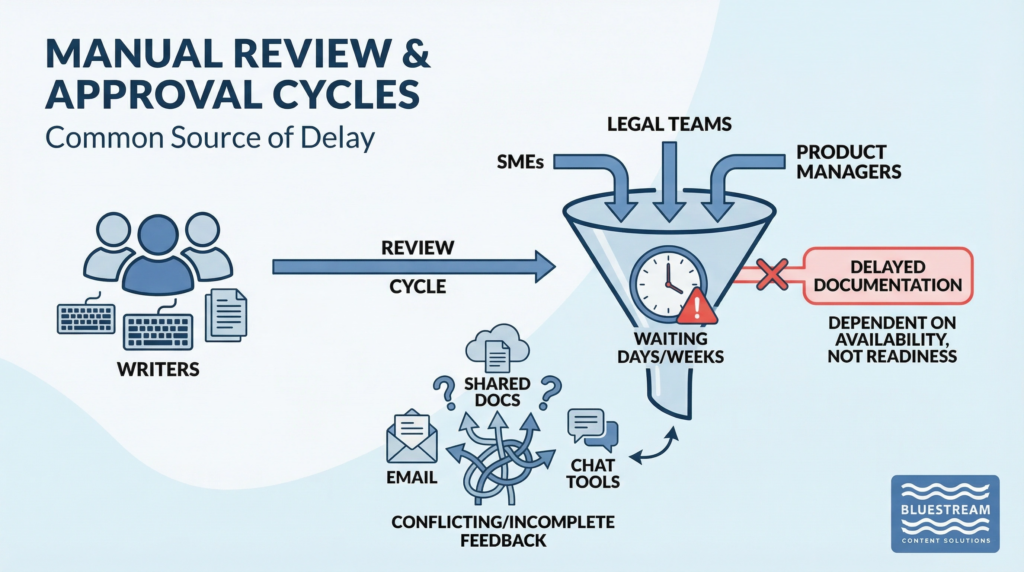
Review cycles are one of the most common sources of delay. Writers often wait days or weeks for subject matter experts, legal teams, or product managers to provide feedback.
Comments arrive via email, shared documents, or chat tools, often conflicting or incomplete. Writers spend time reconciling feedback instead of improving content.
Without clear workflows, version control, or visibility into review status, documentation becomes dependent on availability rather than readiness.
Content Reuse That Isn’t Actually Reusable
Many teams aim for content reuse, but few achieve it consistently. Content is copied and pasted across documents, products, or regions, leading to fragmentation.
When updates are required, writers must track down every instance manually. Over time, reuse turns into duplication, and duplication turns into technical debt.
This makes even small updates slow and risky, especially in regulated or customer-facing environments.
Poor Findability After Publishing
Even when documentation is published on time, it often fails users because it is hard to find.
Writers may not control how content is tagged, indexed, or surfaced in search. PDFs, HTML pages, and multimedia content live in silos, each with different search behavior.
When users cannot find answers, documentation teams receive more support requests and ad hoc update requests, pulling writers away from planned work.
Last Minute Changes & Release Pressure
Documentation is frequently treated as a final step rather than an integral part of product development. Writers receive late breaking changes just before release and are expected to update content instantly.
Without flexible delivery systems, even small changes can require full republishing cycles. This creates stress, increases errors, and reinforces the perception that documentation slows things down rather than enabling releases.
Lack of Insight Into How Documentation Is Used
Many teams do not have clear visibility into how their documentation performs once it is live.
Without analytics, writers cannot see what users search for, where they struggle, or which content is outdated or unused. As a result, improvement efforts rely on assumptions instead of evidence.
This makes prioritization harder and keeps writers reacting instead of planning.
Why These Bottlenecks Persist
Most documentation bottlenecks are not caused by people. They are caused by systems that have not evolved alongside content volume, delivery channels, and user expectations.
As documentation grows more complex, teams need better ways to manage content flow, reuse, delivery, and feedback. Without that foundation, even highly skilled writers are forced into inefficient processes.
Moving Beyond the Bottleneck
Addressing documentation bottlenecks does not require working faster or writing more. It requires removing friction from the system around the writers.
Teams that succeed tend to focus on clear workflows that reduce review delays, centralized content delivery rather than duplicated publishing, metadata and structure that support reuse and findability, flexible platforms that allow rapid updates without full republishing, and analytics that inform continuous improvement.
When these elements are in place, documentation stops being a bottleneck and becomes a strategic asset that scales with the organization.
Final Thoughts
Technical writers want to do their best work. When documentation slows down, it is usually a signal that the surrounding processes and tools need attention.
By identifying where bottlenecks occur and addressing them systematically, documentation teams can move faster, reduce frustration, and deliver better experiences for users and stakeholders alike.
What is a documentation bottleneck?
A documentation bottleneck occurs when processes, tools, or workflows slow down the creation, review, or delivery of documentation. This can happen even when writers are experienced and well staffed. Bottlenecks are usually caused by inefficient systems rather than individual performance.
Why do technical writers experience bottlenecks so often?
Technical writers often depend on multiple stakeholders, tools, and approval cycles. When workflows are unclear or tools are disconnected, even small updates can take longer than expected. As documentation volume grows, these issues become more visible and harder to manage.
Are documentation bottlenecks caused by writers or by tools?
In most cases, bottlenecks are caused by tools and processes rather than writers. Writers typically spend significant time managing handoffs, tracking versions, and coordinating feedback instead of writing. Improving systems often has a greater impact than increasing staffing.
How do review and approval processes slow documentation down?
Reviews can slow documentation when feedback is scattered across email, shared documents, or messaging tools. Delays also occur when review responsibilities are unclear or when content moves through multiple rounds of approval without visibility into status or timelines.
Why does content reuse sometimes make documentation harder to maintain?
Content reuse becomes a problem when reuse is achieved through copying rather than structured management. When reused content is duplicated instead of referenced, updates must be made manually in multiple places, increasing the risk of errors and inconsistencies.
How do review and approval processes slow documentation down?
When users cannot find answers easily, they turn to support teams or documentation writers for help. This creates unplanned work and interrupts planned documentation efforts. Improving findability reduces reactive requests and allows writers to focus on higher value tasks.
What role do analytics play in reducing documentation bottlenecks?
Analytics help documentation teams understand how content is used. By seeing what users search for, where they struggle, and which content is underused, writers can prioritize updates more effectively and avoid spending time on low impact work.
How can documentation teams start addressing bottlenecks?
Teams can start by mapping their documentation workflow and identifying where delays occur. Improving tool integration, clarifying review responsibilities, using metadata consistently, and centralizing content delivery can significantly reduce friction without requiring major process overhauls.
Can better documentation tools eliminate bottlenecks completely?
No tool can eliminate all bottlenecks, but the right tools can reduce unnecessary friction. Platforms that support structured content, centralized delivery, flexible updates, and analytics help writers spend more time creating content and less time managing processes.
Want to See XDelivery CDP & XDocs CCMS in Action?
Looking to modernize your documentation process with AI?
Let’s connect. Contact Bluestream to learn how our native integration with oXygen XML Editor/Author can elevate your structured authoring environment. From authoring to review to multichannel publishing, we support the workflows that power your content lifecycle.
