
Why AI Chatbots Are Only as Good as Your Content Structure

Why AI Chatbots Are Only as Good as Your Content Structure

AI chatbots are quickly becoming a standard part of technical documentation delivery. They allow users to ask questions in natural language, receive direct answers, and avoid searching through long manuals or disconnected content systems.

But there is an important truth that documentation teams need to understand: an AI chatbot is only as good as the content structure behind it.

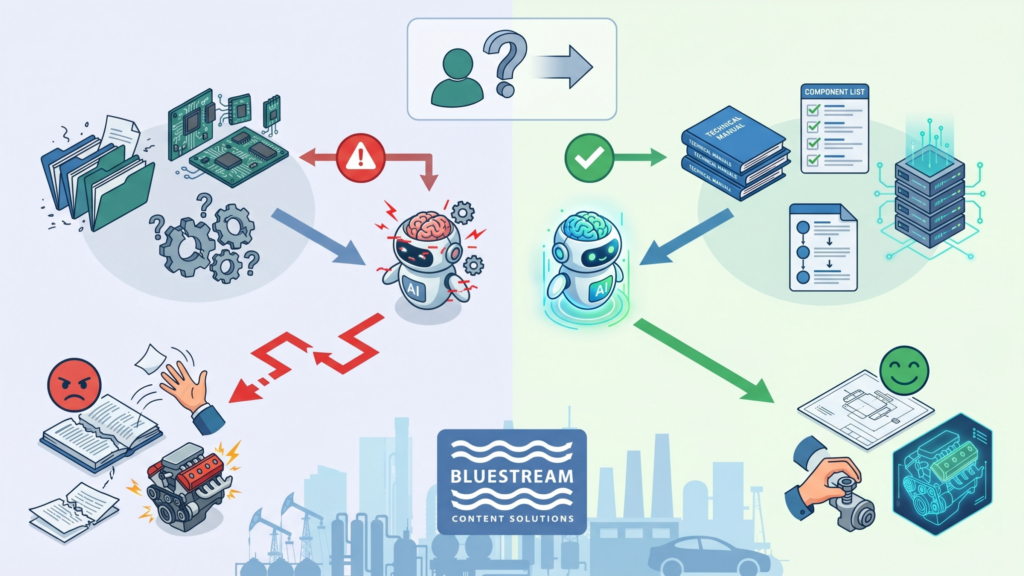
A chatbot may feel intelligent at the interface level, but its answers depend on the quality, organization, and context of the documentation it can access. If the content is poorly structured, duplicated, outdated, or inconsistent, the chatbot will struggle to deliver accurate and useful responses.

In technical documentation, AI success starts with content architecture.

From Content Delivery to Answer Delivery

Traditional content delivery platforms focus on making documentation available. They organize content, provide navigation, and allow users to browse or search for information.

AI chatbots shift the experience from content delivery to answer delivery.

Instead of forcing users to locate the right document, open it, scan sections, and interpret the information themselves, an AI chatbot can retrieve the most relevant content and present it as a direct response.

For documentation teams, this changes the role of a delivery platform. It is no longer just a place where documentation is published. It becomes an interactive knowledge layer that helps users find and apply information faster.

AI Chatbots Do Not Magically Fix Poor Documentation

It is tempting to see AI chatbots as a shortcut. If users cannot find answers, add a chatbot. If search is weak, add AI. If documentation is scattered, let the chatbot sort it out.

In practice, this rarely works.

AI chatbots rely on retrieval systems to find relevant content before generating an answer. If the source content is disorganized, the chatbot may retrieve the wrong topic, mix information from different versions, or provide vague answers because the documentation lacks clear boundaries.

AI can improve access to documentation, but it cannot reliably compensate for poor structure.

Why Content Structure Matters

Content structure gives AI systems the signals they need to understand what information means.

In technical documentation, not all content serves the same purpose. A procedure is different from a concept. A safety warning is different from a troubleshooting note. A product-specific instruction is different from a general overview.

When content is clearly structured, AI systems can identify these distinctions more accurately. When everything is stored in long, unstructured documents, the chatbot has less context to work with.

Strong content structure helps the chatbot understand what content is, when it applies, and how it should be used.

Why AI Chatbots Are Only as Good as Your Content Structure | Bluestream | GIF Banner

The Problem with Large, Unstructured Documents

Many documentation libraries still rely heavily on large PDFs or long-form manuals. These formats may be readable by humans, but they are difficult for AI systems to interpret precisely.

Large documents often contain multiple topics, audiences, product versions, and content types in one place. When an AI system retrieves a section from that document, it may not understand whether the information applies to the user’s specific question.

This can lead to incomplete or misleading answers.

Breaking documentation into smaller, focused topics improves retrieval accuracy. Each topic should answer a specific question, explain a specific concept, or support a specific task.

Metadata Gives AI Context

Metadata is one of the most important foundations for AI-ready documentation.

Metadata tells systems important details about content, such as product model, version, audience, language, region, lifecycle status, and content type. This context helps AI chatbots retrieve the right information and avoid surfacing content that is outdated, internal-only, or irrelevant.

For example, if a user asks for a maintenance procedure for a specific product model, metadata can help the chatbot retrieve the correct version instead of a similar procedure for another model.

Without metadata, AI has to guess. With metadata, it can make more informed retrieval decisions.

Discover how structured content enables AI-driven search, smarter documentation delivery, and better user experiences across complex manufacturing environments…

Topic-Based Authoring Improves AI Retrieval

Topic-based authoring is especially useful for AI chatbot performance. Instead of creating large documents, technical writers create smaller pieces of content focused on a single purpose.

A topic might explain a concept, describe a task, provide troubleshooting steps, or define reference information. Each topic can be tagged, reused, updated, and delivered independently.

This is valuable because AI systems retrieve content in chunks. If each chunk is clear and self-contained, the chatbot is more likely to generate a useful answer.

Well-written topics also make it easier for users to verify the chatbot’s response against the source documentation.

Consistency Reduces Confusion

AI chatbots perform better when documentation uses consistent terminology, structure, and writing patterns.

If one manual says “restart,” another says “power cycle,” and another says “reinitialize,” the chatbot may still understand the relationship through semantic search. However, inconsistency increases the chance of confusion, especially in safety-critical or product-specific contexts.

Consistent headings, terminology, metadata, and topic types all improve the reliability of AI-assisted answers.

For documentation teams, consistency is no longer just a style concern. It directly affects AI performance.

Governance Protects Answer Quality

AI chatbots should retrieve answers from approved and trusted content. This makes governance essential.

Documentation teams need clear processes for reviewing, approving, updating, and retiring content. Without lifecycle control, a chatbot may surface outdated or draft information.

Governance also helps define which content can be used in customer-facing chatbot responses and which content should remain internal.

In technical documentation, answer quality depends on trust. Trust depends on strong content governance.

Why AI Chatbots Are Only as Good as Your Content Structure | Bluestream Blog Image example

AI Makes Content Problems More Visible

One unexpected effect of AI chatbots is that they expose weaknesses in documentation structure.

If users repeatedly ask questions the chatbot cannot answer, it may reveal missing topics, unclear headings, weak metadata, or content that is too buried to retrieve effectively. If the chatbot returns inconsistent answers, it may point to duplicated or conflicting documentation.

This feedback can be extremely valuable.

Rather than treating chatbot failures as purely technical issues, documentation teams should view them as signals about content quality and structure.

Preparing Content for AI Chatbots

Before deploying an AI chatbot for technical documentation, teams should review how their content is organized.

Useful preparation steps include:

• Break large documents into focused topics
• Apply consistent metadata
• Identify outdated or duplicate content
• Separate internal and customer-facing information
• Standardize terminology and headings
• Define clear ownership and review workflows

These steps improve chatbot performance and strengthen the documentation system overall.

Final Thoughts

AI chatbots can transform how users interact with technical documentation, but they do not work well in isolation. Their success depends on the content structure behind them.

Structured topics, consistent metadata, clear governance, and well-maintained documentation all help AI chatbots retrieve better answers and build user trust.

For technical documentation teams, the message is simple: before investing in AI at the interface level, invest in the structure beneath it.

The better your content structure, the better your chatbot will perform.

Want to See Metadata Strategies in Action?

Want to see how a modern documentation portal can support Right to Repair and improve access to your technical content?

Explore how XDelivery helps manufacturers deliver structured, searchable, and AI-ready documentation across all products and user groups.

👉 https://bluestream.com/products/xdelivery/

FAQ: AI Chatbots and Content Structure

Why does content structure matter for AI chatbots?

Content structure helps AI chatbots understand what information means, where it applies, and how it should be used. Clear topics, metadata, and consistent formatting improve answer accuracy.

Can an AI chatbot fix poor documentation?

No. An AI chatbot can improve access to documentation, but it cannot reliably fix outdated, duplicated, or poorly organized content. Strong documentation structure is still essential.

What type of content works best for AI chatbots?

AI chatbots work best with focused, topic-based content that answers specific questions or supports specific tasks. Procedures, troubleshooting topics, warnings, and reference content should be clearly separated.

How does metadata improve chatbot answers?

Metadata gives the chatbot context such as product version, audience, language, region, and content type. This helps the system retrieve the most relevant and appropriate answer.

Why is governance important for AI chatbot content?

Governance ensures the chatbot retrieves approved, current, and trustworthy documentation. It helps prevent outdated, draft, or internal-only content from appearing in user-facing answers.

What should documentation teams do before launching an AI chatbot?

Teams should review their content structure, remove duplicates, apply consistent metadata, standardize terminology, and make sure ownership and review workflows are clear.

Facebook
Twitter
LinkedIn

Search

Categories

Empowering Organizations with Documentation Efficiency

At Bluestream, we are committed to providing exceptional technology and expertise to help organizations overcome their product documentation challenges and achieve their goals efficiently. Partner with us to unlock the full potential of your documentation and enhance your overall productivity.

Sign-up for the latest Bluestream News

Close