

Support teams are often asked questions that already have answers in technical documentation. The challenge is not always that the documentation is missing. More often, users cannot find the right answer quickly enough.
This creates a familiar problem for manufacturers, software providers, and technical product teams. Customers, technicians, dealers, and internal users open support tickets for installation steps, troubleshooting guidance, configuration details, or product information that already exists somewhere in the documentation set.
AI is helping change this pattern.
By improving how users search, retrieve, and interact with documentation, AI can reduce documentation-related support tickets and make self-service support more effective.
Why Documentation-Related Support Tickets Happen
Documentation-related support tickets usually happen when there is a gap between the information available and the information users can actually access or understand.
A user may not know the correct terminology. A technician may search by symptom rather than product name. A customer may not know which manual applies to their product version. Even when the answer exists, it may be buried inside a long PDF, scattered across multiple systems, or written in language that does not match how users ask questions.
When users cannot find a clear answer quickly, they contact support.
This means support teams often spend valuable time answering repeat questions instead of focusing on complex issues that require investigation.
How AI Improves Documentation Search
Traditional search depends heavily on keywords. If users search using the wrong terms, they may not find the correct result.
AI-powered search works differently. It can use semantic search to understand the meaning behind a question, not just the exact words. This allows users to ask questions in natural language and still receive relevant documentation results.
For example, a user might search for “machine won’t restart after shutdown,” while the documentation uses the phrase “startup failure after power cycle.” A traditional search may miss the connection. AI-powered retrieval is better able to identify the relationship between those concepts.
This improves findability and reduces the need for users to ask support for help.

From Search Results to Direct Answers
One of the biggest advantages of AI in documentation is the shift from search results to answers.
Instead of returning a long list of documents, an AI-powered documentation system can retrieve the most relevant topic, extract the useful information, and present it in a clear response.
This is especially valuable for common support questions, such as:
• How do I configure this setting?
• Which part number applies to this model?
• What does this error code mean?
• What is the correct troubleshooting procedure?
• Where can I find the latest installation steps?
When users receive a direct answer, they are less likely to create a support ticket.
Why Structured Content Matters
AI is only as effective as the documentation it can access. If content is outdated, duplicated, poorly structured, or inconsistent, AI may struggle to retrieve the right answer.
Structured content makes AI more reliable.
When documentation is organized into clear topics, enriched with metadata, and connected through defined relationships, AI systems can retrieve more precise information. They can distinguish between procedures, reference content, warnings, troubleshooting steps, and product-specific guidance.
For documentation teams, this means AI does not replace good content practices. It depends on them.
AI Chatbots as a Self-Service Support Channel
AI chatbots are becoming an important interface for technical documentation. Instead of forcing users to browse through manuals or search pages, chatbots allow users to ask questions conversationally.
A well-designed documentation chatbot can retrieve answers from approved technical content and guide users to the relevant source material. This makes documentation easier to use and more accessible for non-expert users.
For support teams, the benefit is clear. Routine questions can be answered automatically, while complex or unresolved issues can still be escalated to a human agent.
This creates a better balance between self-service and assisted support.
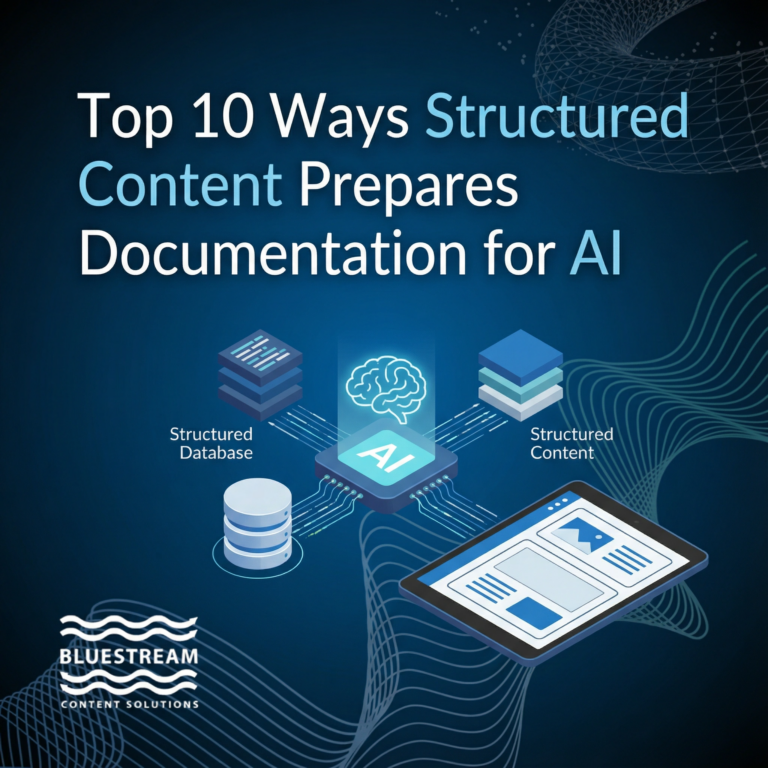
Discover how structured content enables AI-driven search, smarter documentation delivery, and better user experiences across complex manufacturing environments…
Reducing Repeat Questions
Many documentation-related support tickets follow predictable patterns. Users ask the same questions about setup, errors, compatibility, maintenance, or configuration.
AI can help identify and reduce these repeat questions in two ways.
First, it can answer common questions automatically through search or chat. Second, it can reveal which questions users are asking most often. These insights help documentation teams improve the source content.
If users repeatedly ask the same question, it may indicate that the documentation is unclear, difficult to find, or missing an important explanation.
In this way, AI supports both ticket reduction and continuous documentation improvement.
Better Support for Field Technicians and Customers
In manufacturing and technical service environments, users often need information quickly. Field technicians may be working on mobile devices, in remote locations, or under time pressure. Customers may need simple guidance without understanding internal terminology.
AI-powered documentation delivery helps by making information easier to retrieve in real-world conditions.
A technician can ask a question by symptom. A customer can describe a problem in plain language. A support agent can quickly surface the right procedure while handling a case.
This improves response time and increases confidence in the documentation system.
Keeping AI Answers Trustworthy
Reducing support tickets should not come at the expense of accuracy. In technical documentation, especially in manufacturing, safety, compliance, and product reliability matter.
AI systems should be grounded in approved documentation, not uncontrolled sources. Users should be able to trace answers back to source content. Outdated or internal-only information should be excluded from user-facing responses.
Trustworthy AI documentation systems rely on governance, metadata, version control, and clear content ownership.
When these controls are in place, AI can support users confidently without creating unnecessary risk.

The Role of Documentation Teams
AI does not remove the need for technical writers. It increases the importance of their work.
Documentation teams are responsible for creating the structured, accurate, and reusable content that AI systems depend on. They also play a key role in reviewing user questions, identifying content gaps, and improving the documentation experience over time.
As AI becomes part of support workflows, documentation teams become even more central to customer success and operational efficiency.
What Organizations Should Measure
To understand whether AI is reducing documentation-related support tickets, organizations should track both support and documentation metrics.
Useful measures include:
• Repeated support questions
• Search terms that lead to no useful result
• Chatbot questions and answer success rates
• Documentation pages used before ticket creation
• Ticket deflection rates
• Content gaps identified through user behavior
These insights help teams understand where AI is working and where documentation still needs improvement.
Final Thoughts
AI can play a major role in reducing documentation-related support tickets, but only when it is built on strong documentation foundations.
By combining structured content, semantic search, metadata, and AI chat interfaces, organizations can help users find answers faster and resolve routine issues without contacting support.
The result is a better support experience for everyone. Users get answers more quickly, support teams focus on higher-value work, and documentation becomes an active part of the service ecosystem rather than a static resource.
Want to See Metadata Strategies in Action?
Want to see how a modern documentation portal can support Right to Repair and improve access to your technical content?
Explore how XDelivery helps manufacturers deliver structured, searchable, and AI-ready documentation across all products and user groups.
FAQ: AI and Documentation-Related Support Tickets
How does AI reduce documentation-related support tickets?
AI helps users find answers that already exist in technical documentation. By using semantic search and chatbot interfaces, users can ask questions in natural language and receive relevant answers without opening a support ticket.
Can AI replace support teams?
No. AI is best suited for routine questions, troubleshooting guidance, and common documentation-based answers. Support teams are still essential for complex issues, escalations, and cases that require human judgment.
Why does structured content matter for AI support?
Structured content helps AI retrieve the right information more accurately. When documentation is organized into clear topics with metadata, AI can better understand product versions, task types, warnings, and troubleshooting steps.
What kinds of support questions can AI answer?
AI can help answer common questions about installation, configuration, error codes, troubleshooting procedures, product compatibility, and maintenance instructions.
How can documentation teams use AI insights?
Documentation teams can review common AI queries, unanswered questions, and repeated support topics to identify content gaps and improve documentation over time.
Is AI safe to use with technical documentation?
Yes, when it is grounded in approved, up-to-date documentation. AI responses should be traceable to source content, especially in safety-critical or compliance-sensitive environments.
